

Blog
Testosterone Enanthate Half-Life & Injection Frequency: How Long It Lasts and When to Inject

Testosterone enanthate has a terminal half-life of about 4.5 days after intramuscular injection. That single number drives almost everything about the ester: after one injection, serum testosterone peaks within 8 to 24 hours, halves in about four and a half days, and returns to baseline by roughly day 9. Injecting twice a week keeps levels far steadier than once a week or once every two weeks, because the gap between doses never stretches far past one half-life.
This guide stays strictly pharmacokinetic: what the half-life is and how it was measured, what happens after a single injection, how enanthate compares with other esters, how injection frequency changes the peak-to-trough swing, what different weekly doses produced in a controlled study, and when to draw bloodwork. It is educational information, not medical advice, and it recommends no dose: testosterone is a prescription medicine in Canada, and anyone using it should be under a doctor’s care with regular bloodwork. Our team at Oxygen Pharm publishes these guides so readers can judge claims against evidence rather than marketing.
What the Half-Life of Testosterone Enanthate Actually Is
Testosterone itself clears from the blood within hours. What makes enanthate long-acting is the ester: a seven-carbon fatty acid chain that makes the molecule oil-soluble. Injected into muscle, it forms an oily depot that releases slowly as enzymes cleave the ester bond, freeing active testosterone. Because release from the depot is slower than elimination of the hormone itself, the release step sets the pace — the 4.5-day half-life reported in the pharmacology literature (Kicman 2008).
The table below calculates the remaining fraction directly from that half-life; the infographic repeats it visually. These figures describe the ester’s release, not a measured blood level — real serum testosterone also depends on absorption and individual clearance, which is why the measured data in the next section matters.
What Happens After a Single Injection
The cleanest measured curve comes from Schulte-Beerbühl and Nieschlag (1980): six healthy men received a single injection equivalent to 140 mg of testosterone as either the enanthate or the cypionate ester, with serum hormones tracked for two weeks. With enanthate, serum testosterone rose to four to five times baseline between 8 and 24 hours, then fell steadily and was back to baseline by day 9. Luteinizing hormone (LH) and follicle-stimulating hormone (FSH) stayed suppressed while testosterone remained elevated — direct evidence that the body’s own production switches off while exogenous testosterone is present.
The same study found cypionate produced a near-identical curve, which is why the two esters are often treated as interchangeable. The practical message is the shape: a sharp early peak, then a steady decline — so any schedule with a long gap after the peak, such as once every two weeks, spends the second half of the interval sliding toward baseline.
| Time after one injection | Ester remaining | What the studies show |
|---|---|---|
| Day 0 (injection) | 100% | Depot forms; release begins |
| 8–24 hours | About 90% | Serum testosterone peaks at 4–5× baseline (Schulte-Beerbühl & Nieschlag 1980) |
| Day 4.5 (one half-life) | 50% | Half released |
| Day 9 (two half-lives) | 25% | Back to baseline after a 140 mg dose (Schulte-Beerbühl & Nieschlag 1980) |
| Day 13.5 (three half-lives) | 12.5% | Below baseline; LH and FSH recovering |
| Day 18 (four half-lives) | About 6% | Essentially cleared |
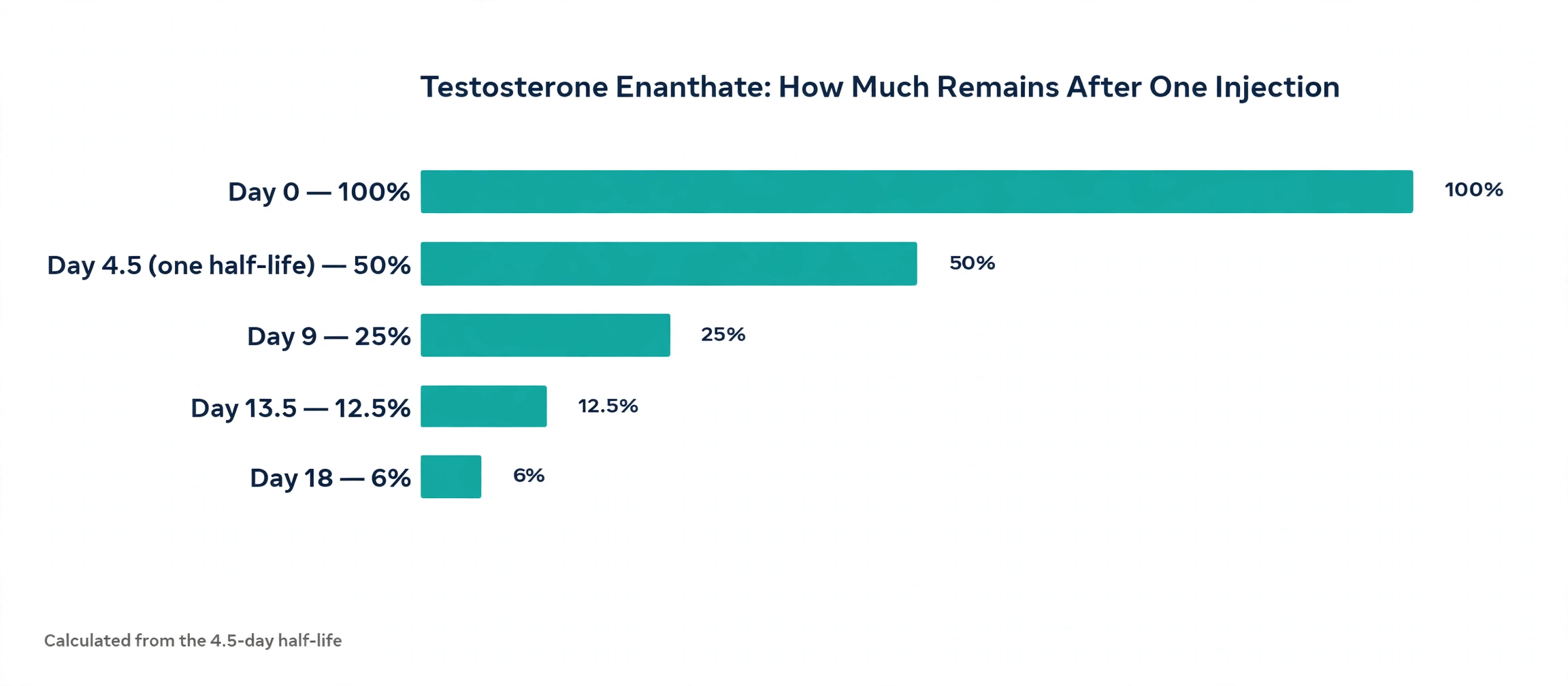
Fraction remaining after one injection — the bars repeat the table above.
Day 0 — 100%
Day 4.5 — 50%
Day 9 — 25%
Day 13.5 — 12.5%
Day 18 — 6%
How Enanthate Compares With Other Testosterone Esters
Every testosterone ester delivers the same active hormone; only the timing changes. Short esters need frequent injections, long esters rare ones, and enanthate sits in the middle. The table uses the half-lives reported in the pharmacology literature (Kicman 2008). Note the cypionate figure: some sources quote about 8 days, others treat it as near-identical to enanthate — the measured serum curves in Schulte-Beerbühl and Nieschlag (1980) were essentially the same, so the practical difference is small.
| Ester | Half-life | Typical injection interval | Best suited to |
|---|---|---|---|
| Propionate | 0.8 days | Every 2–3 days | Short cycles; fastest clearance if use stops |
| Enanthate | 4.5 days | Twice weekly or weekly | Most common long-ester choice; balanced peak and trough |
| Cypionate | About 8 days (measured curves near-identical to enanthate) | Weekly or every 2 weeks | Near-interchangeable with enanthate in practice |
| Undecanoate | 21–34 days (depends on the carrier oil) | Every 10–14 weeks | Long-term replacement with the fewest injections |
Our head-to-head, Testosterone Enanthate vs Cypionate, goes deeper into why the small half-life gap rarely matters at twice-weekly dosing. The testosterone enanthate 250 mg/mL product is the standard enanthate preparation, and the broader Injectable Steroids category lists the other esters alongside it.
Injection Frequency: Weekly, Twice Weekly, or Every Two Weeks?
The wider the gap between injections relative to the half-life, the bigger the swing between the peak just after a dose and the trough just before the next one. Using the 4.5-day half-life as the guide, the pattern is straightforward:
- Every two weeks (200 mg): by day 14, roughly 12% of the dose remains, so the second week is spent sliding toward baseline. The older clinical literature describes exactly this: supraphysiologic levels for the first two to three days, then a steady decline to sub-physiologic levels before the next injection. Energy, libido, and mood can track that swing.
- Once weekly: the trough lands at about one third of the peak (calculated from the half-life: after 7 days, about 34% of the dose remains). A noticeable swing, but far smaller than the two-week schedule.
- Twice weekly (every 3–4 days): the trough stays at roughly 60% of the peak, because the next dose arrives before one full half-life has passed. This is the steadiest schedule for this ester, and the one most clinicians settle on when stable levels matter.
For a full walkthrough of building a first cycle around this ester, see our First Testosterone Cycle Guide.

What Different Weekly Doses Actually Produce
The best controlled data come from Bhasin and colleagues (2001): 61 healthy young men (aged 18–35) had their natural testosterone suppressed with a GnRH agonist, then received fixed weekly doses of testosterone enanthate — 25, 50, 125, 300, or 600 mg — for 20 weeks. Trough testosterone and fat-free mass gained show a clear dose-response:
| Weekly testosterone enanthate dose | Average trough testosterone | Fat-free mass gained in 20 weeks |
|---|---|---|
| 25 mg | 253 ng/dL | No significant gain |
| 50 mg | 306 ng/dL | No significant gain |
| 125 mg | 542 ng/dL | +3.4 kg |
| 300 mg | 1,345 ng/dL | +5.2 kg |
| 600 mg | 2,370 ng/dL | +7.9 kg |
First, 125 mg a week — roughly a replacement-level dose — produced a trough of 542 ng/dL, inside the normal range, and still added 3.4 kg of fat-free mass. Second, gains kept rising with dose, but so did the side effects: haemoglobin rose and HDL (“good”) cholesterol fell as concentrations climbed. Higher doses buy more muscle at a measurable cost to blood markers, which is why bloodwork — not feel — is the only honest way to judge a dose. Our Testosterone Bloodwork Guide lists exactly which markers to track and when.
How Long Until It Builds Up — and How Long Until It Clears
With repeated injections, testosterone accumulates until the amount going in each week matches the amount cleared — the steady state. The rule of thumb is about five half-lives, which for enanthate is roughly 22.5 days, or just over three weeks. Levels measured before that point are still climbing, which is why bloodwork drawn in the first two weeks of a new schedule is misleading.
Clearance follows the same clock in reverse: after the last injection, about 97% of the ester is gone after five half-lives — roughly 22 days. That timing matters for post-cycle therapy, because starting PCT while testosterone is still being released suppresses recovery. Our PCT timing guide gives the wait for every common ester, including enanthate.
When to Draw Bloodwork
Because levels swing between injections, timing matters as much as what is measured. The Endocrine Society guideline (Bhasin et al. 2018) recommends measuring testosterone midway between injections — or as a trough just before the next dose — and aiming for the middle of the normal range. A peak drawn the morning after an injection looks high; a trough on day 13 of a two-week schedule looks low. Neither number alone describes the treatment.
The same guideline sets the key safety threshold: if haematocrit rises above 54%, testosterone should be stopped or the dose reduced until it falls, because thicker blood raises clotting risk. PSA, lipids, and blood pressure are monitored alongside it. Get baseline bloodwork before starting and repeat labs at 3–6 months, then at least yearly — and see a doctor promptly for chest pain, breathlessness, leg swelling, or a painful erection lasting more than four hours.
Frequently Asked Questions
What is the half-life of testosterone enanthate?
About 4.5 days after intramuscular injection (Kicman 2008): half of a dose has been released after 4.5 days, a quarter remains after 9 days, and roughly 6% after 18 days.
How often should testosterone enanthate be injected?
Twice a week gives the steadiest levels: the next dose arrives before one full half-life has passed, keeping the trough at roughly 60% of the peak. Once a week swings further; once every two weeks produces the largest peak-to-trough swing.
How long does testosterone enanthate stay in your system?
After one injection, serum testosterone returns to baseline by about day 9 (Schulte-Beerbühl & Nieschlag 1980). After repeated injections, about five half-lives — roughly 22 days — are needed for levels to fall to near zero, and the same period to reach a steady state when starting.
Is testosterone enanthate the same as testosterone cypionate?
They deliver the same hormone and their measured serum curves are near-identical (Schulte-Beerbühl & Nieschlag 1980). Cypionate’s quoted half-life is slightly longer, about 8 days, but at twice-weekly dosing the difference is negligible — the choice usually comes down to availability and price.
References
- Kicman AT. Pharmacology of anabolic steroids. British Journal of Pharmacology. 2008;154(3):502–521. doi:10.1038/bjp.2008.165. PMCID: PMC2439524.
- Schulte-Beerbühl M, Nieschlag E. Comparison of testosterone, dihydrotestosterone, luteinizing hormone, and follicle-stimulating hormone in serum after injection of testosterone enanthate or testosterone cypionate. Fertility and Sterility. 1980;33(2):201–203. PMID: 7353699.
- Bhasin S, Woodhouse L, Casaburi R, et al. Testosterone dose-response relationships in healthy young men. American Journal of Physiology – Endocrinology and Metabolism. 2001;281(6):E1172–E1181.
- Bhasin S, Brito JP, Cunningham GR, et al. Testosterone therapy in men with hypogonadism: An Endocrine Society clinical practice guideline. Journal of Clinical Endocrinology & Metabolism. 2018;103(5):1715–1744.
Disclaimer: This article is educational information only, not medical advice. Testosterone enanthate is a prescription medicine; dosing, injection technique, and monitoring should be decided with a doctor. Never share needles or vials, always use sterile technique, and seek medical care promptly for any concerning symptom.