

Blog
Testosterone Bloodwork Guide: What to Test, When to Draw, and How to Read Results

If you use testosterone, bloodwork is the only way to know what is actually happening inside your body. How you feel and what a dose calculator predicted are poor substitutes for a lab result. A sensible panel, drawn at the right time, tells you whether testosterone is in range, whether red blood cells are climbing too high, whether estrogen is rising, and whether liver, lipid, and prostate markers need attention.
The short answer: get a baseline panel before you start, draw testosterone midway between injections for long esters, recheck it 2 to 3 months after starting, check hematocrit at baseline, at 3 months, and then annually, and repeat the full panel at least once a year. Both the Endocrine Society and the American Urological Association (AUA) recommend a standardized plan built around symptoms, testosterone, hematocrit, and prostate risk — not a single number read in isolation.
Educational information only, not medical advice. Testosterone is a controlled substance in Canada; if any result below is outside range, or you develop symptoms, see a doctor promptly rather than adjusting a dose on the basis of an article.
Why bloodwork matters more than how you feel
Testosterone affects more than muscle: it raises red blood cell production, converts in part to estrogen, can suppress your own natural production, and can shift lipids and liver markers. Most of those changes are silent at first. You can feel strong while hematocrit creeps upward, or flat while testosterone reads high — timing, estrogen, prolactin, sleep, and stress all shape symptoms.
Bloodwork also protects against two common errors: chasing a single number — one badly timed draw can mislead by hundreds of points — and assuming no news is good news. The serious problems of testosterone therapy, including erythrocytosis and fertility suppression, are usually found on a lab report before they are felt. Our companion guide to first testosterone cycles covers dosing and PCT structure; this guide covers the monitoring alongside any cycle.
The core bloodwork panel: what to test and why
The table below is the panel worth asking a clinician about. Testosterone therapy is a whole-body intervention, so it runs broader than a single testosterone test. Not every clinician orders every marker at every visit, but this is the complete picture to work from.
| Marker | What it tells you | When to check | Flag to discuss with a doctor |
|---|---|---|---|
| Total testosterone | Overall testosterone level; the headline monitoring number | Baseline, midway between injections, 2–3 months after starting, then annually | Below your lab range, or far above it, on a correctly timed draw |
| Free testosterone / SHBG | How much testosterone is unbound and active; SHBG explains why equal totals can feel different | Baseline, and when total and symptoms disagree | Low free testosterone despite a normal total |
| Estradiol (E2) | Estrogen level; rises as testosterone aromatizes | Baseline and with symptoms (water retention, nipple sensitivity, mood change) | Well above your lab range, or symptoms at any level |
| Hematocrit / hemoglobin (CBC) | Red blood cell share of blood; the key safety marker on testosterone | Baseline, 3 months, then annually | Hematocrit above 54% — guidelines say stop and reassess |
| PSA (men over 40) | Prostate marker used in prostate-risk monitoring | Baseline and 3–12 months after starting | Above 4 ng/mL, or above 3 ng/mL if at increased prostate risk |
| LH and FSH | Whether natural production is suppressed; essential before and after a cycle | Baseline and in PCT planning | Suppressed LH/FSH after a cycle |
| Lipids (cholesterol panel) | HDL/LDL balance, which steroids can worsen | Baseline and annually, sooner on oral compounds | Marked HDL fall or LDL rise |
| Liver enzymes (ALT/AST) | Liver stress, most relevant with oral steroids | Baseline and during/after oral use | ALT/AST several times the upper limit |
| Prolactin | Can rise with some compounds and suppress libido | Baseline, and with libido or nipple symptoms | Persistently high prolactin |
Two practical points: use the same laboratory where possible, because ranges and assays differ between labs, and keep your own record — date, dose, ester, days since the last injection, and every result.
Reading your testosterone result: ng/dL, nmol/L, and the reference range
Canadian labs report total testosterone in nanomoles per litre (nmol/L); many American sources use nanograms per decilitre (ng/dL). Multiply nmol/L by 28.84 to get ng/dL, or divide ng/dL by 28.84 to get nmol/L: 10 nmol/L is about 288 ng/dL, 15 nmol/L about 433 ng/dL, and 25 nmol/L about 721 ng/dL. Never compare a Canadian result with an American target without converting first.
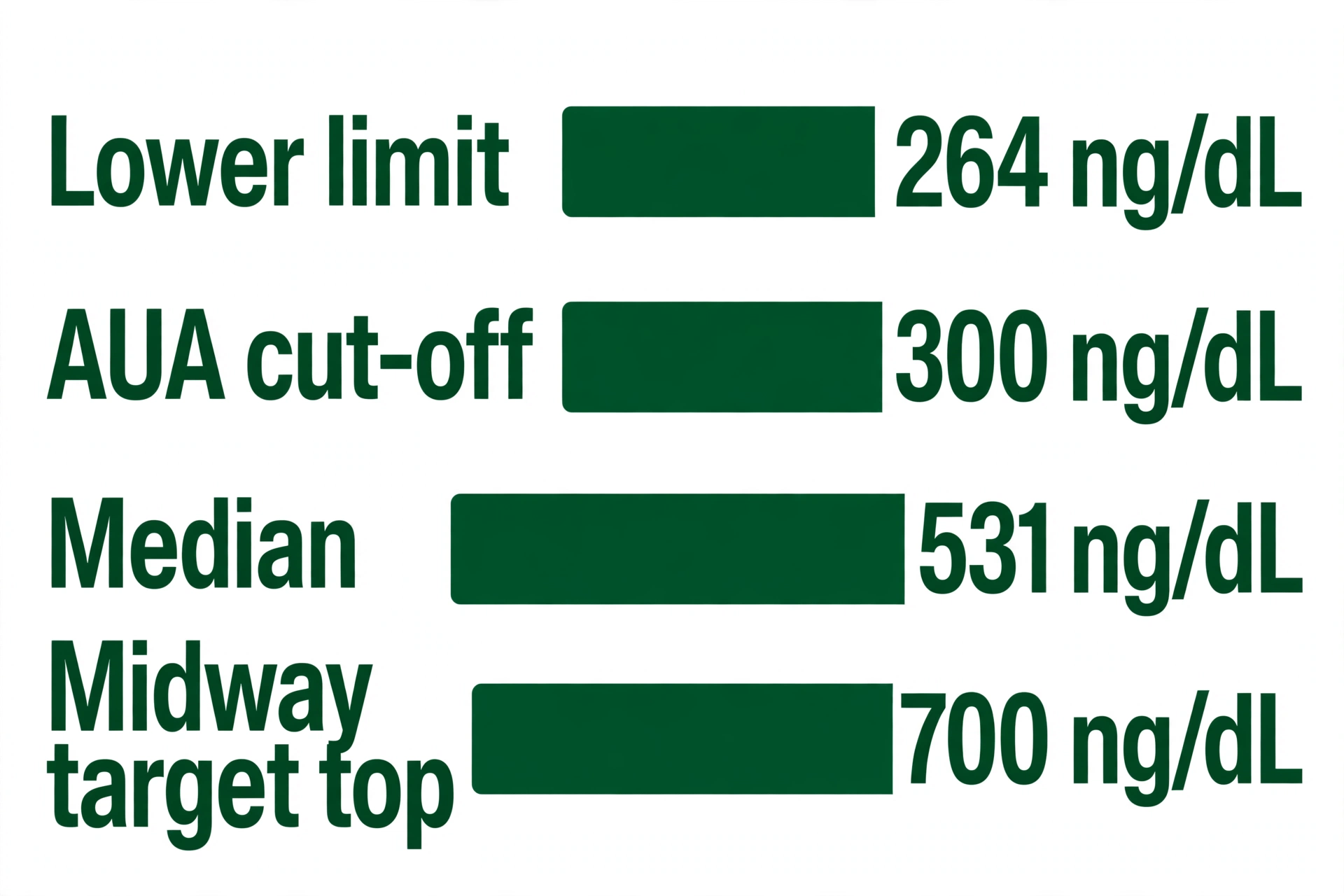
What counts as normal? A harmonization study of 9,054 men from four cohort studies, calibrated against a reference method, found a normal range of 264 to 916 ng/dL (9.2 to 31.8 nmol/L) in healthy, non-obese men aged 19 to 39, with a median of 531 ng/dL. The AUA guideline uses below 300 ng/dL (about 10.4 nmol/L), on two early-morning tests plus symptoms, as a reasonable deficiency cut-off. The Endocrine Society recommends aiming for the mid-normal range during treatment, with fasting morning total testosterone, confirmed on a repeat draw, as the initial test.
For injectable enanthate or cypionate, AUA guidance is precise: measure midway between injections and aim for 400 to 700 ng/dL. These esters peak in the first days after injection and fall toward a trough before the next one, so a peak draw flatters the result and a trough draw understates it. Our testosterone enanthate vs cypionate head-to-head explains the half-life difference, and the testosterone enanthate 250 mg/mL page lists the long-ester format this rule applies to.
Total testosterone: guideline reference points (ng/dL)
Bars scaled to 916 ng/dL. Sources: Travison et al. 2017; AUA guideline 2018.
When to draw blood: a timing schedule that actually works
| When | What to test | Why this timing |
|---|---|---|
| Before you start (baseline) | Full panel, including PSA if over 40 | Without a baseline you cannot tell what changed |
| Midway between injections | Total testosterone (enanthate/cypionate) | Midway reflects the average level |
| 2–3 months after starting | Total testosterone, symptoms review | AUA monitoring point for dose adequacy |
| 3 months after starting | Hematocrit, plus prostate-risk review | Red blood cells rise gradually; 3 months catches the climb |
| 3–12 months after starting | PSA and prostate-risk review | Endocrine Society first-year monitoring window |
| Annually thereafter | Full panel, symptoms, hematocrit | Long-term safety net; sooner if dose or symptoms change |
For morning diagnostic draws — used to decide whether testosterone is genuinely low before treatment — the rules are stricter: fasting, early morning, and repeated, because testosterone peaks in the morning. A single afternoon draw is not a diagnosis. Mid-cycle, note the days since injection alongside the result so it can be interpreted honestly.
Red flags: when a result means “see a doctor now”
Most abnormal results call for a prompt appointment, not panic — but a few call for urgency. Do not try to “fix” these by changing a dose yourself:
- Hematocrit above 54%: both guidelines treat this as the point to stop therapy until hematocrit falls, evaluate for hypoxia and sleep apnea, and restart only at a reduced dose if a clinician advises it.
- PSA above 4 ng/mL (above 3 ng/mL at increased prostate risk): guidelines recommend against starting testosterone without further urological evaluation, with prostate risk reassessed 3 to 12 months after starting.
- Chest pain, breathlessness, leg swelling, or severe headache: seek urgent care the same day.
- Severe mood change or thoughts of self-harm: seek help immediately. Hormonal swings, suppression, and withdrawal can all affect mood.
- Signs of infection at an injection site — spreading redness, heat, swelling, fever, or pus: this needs medical treatment, not home management.
Also watch slow trends: HDL drifting down, liver enzymes creeping up on oral compounds, estradiol rising with water retention and nipple sensitivity, and LH/FSH staying suppressed after a cycle ends. Those trends are what the annual panel is for, and why PCT timing — covered in our guide on when to start PCT after each ester — is itself a bloodwork decision. The post cycle therapy category and the testosterone cypionate 250 mg/mL page are the money pages this guide supports, and estrogen management on cycle covers estradiol in depth.
What bloodwork cannot tell you
Bloodwork has limits worth stating plainly. A normal panel does not make unsupervised testosterone use safe, and it does not certify a product’s purity or dose — only third-party lab testing of the product itself can do that. A single “in range” result does not prove fertility is intact, because sperm production recovers on its own, slower timetable. And reference ranges describe a population, not a prescription: feeling well at 450 and poor at 800 are both possible, because SHBG, estradiol, sleep, and sensitivity all matter. If numbers and symptoms disagree, take that disagreement to a clinician — do not ignore either side. The team at Oxygen Anabolics publishes these guides to inform conversations with clinicians, not to replace them.
Frequently asked questions
Should I get bloodwork before my first cycle, or only after?
Before, without exception. A baseline is the only way to know what changed, and several markers — hematocrit, PSA, lipids, liver enzymes — can also rule out starting at all.
Why does my Canadian result look “low” compared with American targets?
Almost always, units. Divide ng/dL by 28.84 to get nmol/L, or multiply nmol/L by 28.84 to get ng/dL. A result of 10 nmol/L is about 288 ng/dL — near the AUA 300 ng/dL cut-off. Always convert before comparing, and compare against your own lab’s range first.
When exactly should I draw blood on testosterone enanthate or cypionate?
Midway between injections, per AUA guidance, aiming for 400 to 700 ng/dL. A draw the day after injection measures a peak; a draw the day before the next one measures a trough.
What is the single most important safety marker to watch?
Hematocrit — checked at baseline, at 3 months, and annually, and above 54% therapy should be paused until it falls. Testosterone gets the attention, but hematocrit is the marker most likely to force a pause.
References
- Bhasin S, Brito JP, Cunningham GR, et al. Testosterone Therapy in Men With Hypogonadism: An Endocrine Society Clinical Practice Guideline. Journal of Clinical Endocrinology & Metabolism. 2018;103(5):1715–1744.
- Travison TG, Vesper HW, Orwoll E, et al. Harmonized Reference Ranges for Circulating Testosterone Levels in Men of Four Cohort Studies in the United States and Europe. Journal of Clinical Endocrinology & Metabolism. 2017;102(4):1161–1173.
- Mulhall JP, Trost LW, Brannigan RE, et al. Evaluation and Management of Testosterone Deficiency: AUA Guideline. Journal of Urology. 2018;200(2):423–432.
- Kicman AT. Pharmacology of anabolic steroids. British Journal of Pharmacology. 2008;154(3):502–521.
Disclaimer: educational information only, not medical advice. Testosterone and other anabolic steroids are controlled substances in Canada; always discuss results and symptoms with a qualified clinician.