

Blog
TB-500 Dosage & Loading Phase Explained: How Much, How Often, and When to Step Down
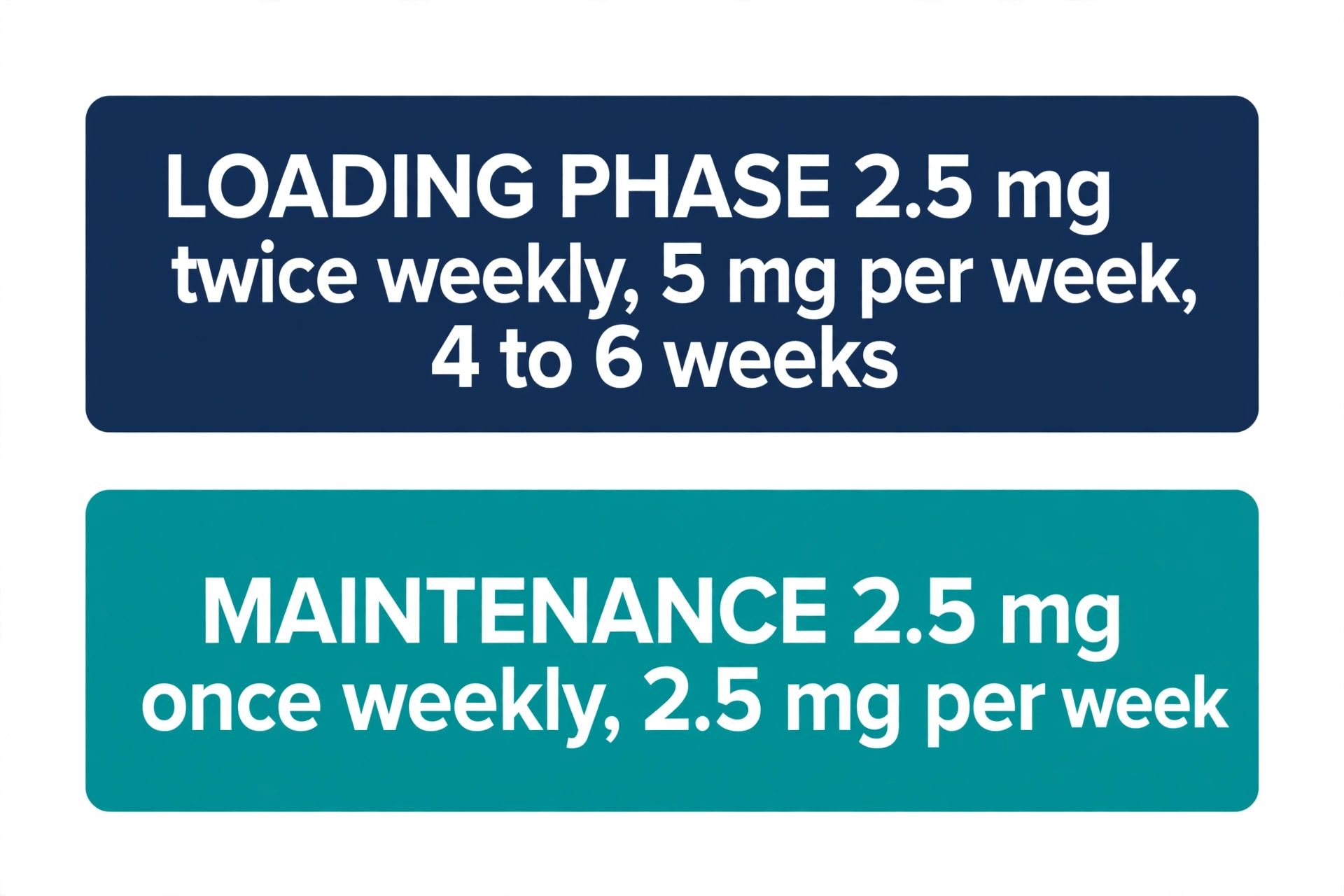
TB-500 has no approved human dose. That single fact shapes everything that follows: every dosing schedule you will read online is a commonly reported practice pattern, not a validated clinical protocol. The pattern most often reported is a loading phase of 2.5 mg twice weekly for 4 to 6 weeks, followed by a maintenance phase of 2.5 mg once weekly.
This guide explains that pattern in full — each phase, the weekly totals and vial maths, what the research actually shows, and where the safety and anti-doping lines sit. It is educational information only, not medical advice. Discuss any injectable peptide with a qualified healthcare professional first.
What TB-500 Actually Is — and What It Is Not
TB-500 is a synthetic fragment related to thymosin beta-4 (Tβ4), a naturally occurring 43-amino-acid protein found in almost all human cells. TB-500 is not the whole protein: it corresponds to a short active region of Tβ4 containing the actin-binding site, the part involved in cell movement. That distinction matters for every claim made about it, because most of the published human and animal research studied the full Tβ4 protein, not the commercial fragment.
Tβ4’s best-characterised job is regulating actin, the scaffold that lets cells change shape and move — in wound models, cell migration toward injury, new blood-vessel formation, and reduced inflammation. But a mechanism is not proof of effect in people, and a fragment is not guaranteed to reproduce everything its parent protein does.
The Commonly Reported Two-Phase Schedule
The schedule below is the pattern reported most consistently across community protocols and peptide guides: a higher-frequency loading phase, then a lower-frequency maintenance phase. It is not an approved dose, and no human trial has validated it for tendon, ligament, or muscle injury. Treat it as a description of what is commonly reported, not as a recommendation.
| Phase | Dose per injection | Frequency | Weekly total | Typical duration |
|---|---|---|---|---|
| Loading | 2.5 mg | Twice weekly | 5.0 mg | 4 to 6 weeks |
| Maintenance | 2.5 mg | Once weekly | 2.5 mg | Ongoing, with regular reassessment |
| Lower reported range | 2.0 mg | Twice weekly (loading) | 4.0 mg | 4 to 6 weeks |
The logic of the two phases is straightforward: the loading phase delivers twice the weekly amount for a limited period, on the theory that it builds up tissue exposure faster, and the maintenance phase then halves the weekly total. The commonly reported TB-500 5 mg vial size makes the maths clean — one vial covers exactly two 2.5 mg doses — which is part of why 2.5 mg became the standard reported unit.
Weekly totals, visualised
Chart data: weekly totals from the protocol table above. Loading (5.0 mg) is double maintenance (2.5 mg); the lower loading range (4.0 mg) sits at 80% of the standard loading total.

Worked Example: Vial Maths for a 5 mg Vial
Reconstitution maths is where dosing errors happen, so work it out before anything else. Using the standard example of a 5 mg vial reconstituted with 1 mL of bacteriostatic water, the concentration is 5 mg per mL. A 2.5 mg dose is therefore 0.5 mL — 50 units on a U-100 insulin syringe, where 100 units equals 1 mL.
Over a 4-week loading phase at 5.0 mg per week, the total is 20 mg, or four 5 mg vials; a 6-week phase totals 30 mg, or six vials. Each 4 weeks of maintenance totals 10 mg, or two vials. If your vial size or dilution volume differs, recalculate — never carry a unit count from one vial size to another. The same sterile-technique principles apply here: use bacteriostatic water, keep everything sterile, refrigerate reconstituted vials as directed, and discard anything cloudy or discoloured.
What the Published Research Actually Shows
Three numbers anchor an honest picture of the evidence, and all three come with the same caveat: they describe the parent protein Tβ4, mostly in animals or in non-injury settings, not injectable TB-500 for sports injuries in people.
First, in a rat full-thickness wound model, topical or intraperitoneal Tβ4 increased re-epithelialisation by 42% over saline controls at day 4 and by as much as 61% at day 7, with treated wounds contracting at least 11% more than controls by day 7. In cell assays from the same study, Tβ4 stimulated keratinocyte migration 2- to 3-fold over medium alone. Second, the only Phase 1 human safety study of intravenous synthetic Tβ4 enrolled 40 healthy volunteers in four cohorts of 10, given single doses of 42, 140, 420, or 1,260 mg and then the same dose daily for 14 days; it was well tolerated with no evidence of dose-limiting toxicity. Third, Tβ4 itself is a 43-amino-acid protein — the fragment sold as TB-500 is a far smaller piece of it.
Read together, those numbers say the parent protein has a real wound-repair signal in animal models and was tolerated intravenously in healthy volunteers. They do not say that 2.5 mg of subcutaneous TB-500 twice weekly heals a tendon in an athlete: there are no completed, published human efficacy trials of the fragment for muscle or tendon repair, and the popular dosing pattern has never been validated in a trial.
Loading, Maintenance, and When to Stop and Reassess
The most common mistake is treating maintenance as indefinite by default. Loading has a defined end — 4 to 6 weeks — and that endpoint is the moment to reassess: is the injury properly diagnosed and managed, and is continued use justified at all? There is no validated total duration or “cycle length” for TB-500. Worsening pain, swelling, redness, fever, numbness, or loss of function means seeing a clinician promptly, not extending a phase.
Skipping loading is sometimes asked about. No trial has compared loading versus maintenance-only dosing for TB-500, so no one can say loading is necessary — only that it is the pattern most often reported. Exceeding the reported range is likewise unsupported: the Phase 1 trial’s large intravenous doses were for the full protein in a clinic, not a licence to raise fragment doses.
Stacking With BPC-157: What Is Known, What Is Not
TB-500 is frequently paired with BPC-157, and the two are sold together as a blend. The pairing has a plausible rationale — BPC-157 is discussed for tendon and gut healing, while Tβ4’s mechanism centres on cell migration and blood-vessel formation — but plausibility is not evidence. There are no published human studies of the combination, and it has not been shown to be more effective, or safer, than either peptide alone. Our BPC-157 dosage guide applies the same honesty rule: no established human dose exists for BPC-157 either. The TB-500 and BPC-157 blend vial is a convenience format, not a clinically tested combination product.
Safety, Sterile Technique, and the Anti-Doping Line
Harm reduction starts with the basics that apply to any injectable: sterile technique every time, a new sterile needle and syringe, bacteriostatic water for reconstitution, no sharing of vials or needles, and proper storage and disposal. Bloodwork cannot validate an unapproved peptide, but a clinician can assess the underlying injury, rule out infection or a more serious cause of pain, and advise on rehabilitation — which is, in most tendon and ligament cases, the intervention with the strongest evidence behind it.
Two regulatory facts should weigh heavily in any decision. TB-500 is not approved by the FDA or Health Canada for any therapeutic use, and it is sold as a research compound. And thymosin beta-4 and its derivatives, including TB-500, are prohibited at all times — in and out of competition — under the World Anti-Doping Agency Prohibited List (S2.3, growth factors). Any athlete subject to anti-doping rules risks a doping violation from its use, regardless of whether it was bought openly or recommended informally. Tested athletes should not use it, period.
Finally, be alert to the quality problem shadowing this category: independent analyses of peptides bought online have repeatedly found contents that did not match their labels. Oxygen Anabolics publishes its lab-test information for customers who want to check it, and the research peptides category lists the store’s peptide range.
Frequently Asked Questions
Is there an official TB-500 dose?
No. TB-500 is not an approved drug, so there is no approved label, no official dose, and no regulator-reviewed prescribing information. The 2.5 mg twice-weekly loading pattern is a commonly reported practice pattern, not a clinical recommendation.
How long does the loading phase last?
In the commonly reported pattern, 4 to 6 weeks at 5.0 mg per week, followed by 2.5 mg once weekly as maintenance. The endpoint of loading is the right moment to reassess with a clinician rather than automatically continuing.
Can I skip the loading phase and start at maintenance?
No trial has compared the two approaches for TB-500, so there is no evidence that loading is necessary or that skipping it is worse. Starting at maintenance simply means half the weekly amount from the start. Do not compensate by raising individual doses without medical advice.
Is TB-500 the same as thymosin beta-4?
No. Thymosin beta-4 is the full 43-amino-acid protein; TB-500 is a synthetic fragment corresponding to a short active region of it. Most published research studied the full protein, so its results cannot be transferred directly to the fragment.
The Bottom Line
TB-500’s dosing story is a two-phase pattern — 2.5 mg twice weekly for 4 to 6 weeks, then 2.5 mg once weekly — built on community practice, not a human trial. The parent protein has wound-repair data in animals and a clean Phase 1 safety record intravenously, but neither validates the fragment’s popular use for sports injuries. Respect the anti-doping ban if you compete, keep technique sterile, and get real injuries assessed.
Disclaimer: This article is educational information only and is not medical advice. TB-500 is not approved for human therapeutic use. Always consult a qualified healthcare professional before starting, stopping, or changing any peptide or medication, and seek prompt medical attention for worsening pain, swelling, fever, or loss of function.
Related reading: BPC-157 vs TB-500: Which Recovery Peptide Fits Your Injury?, BPC-157 and TB-500 Therapeutic Uses, Retatrutide Reconstitution and Dosage.
References
- Malinda KM, Sidhu GS, Mani H, et al. Thymosin beta4 accelerates wound healing. Journal of Investigative Dermatology. 1999;113(3):364–368.
- Ruff D, Crockford D, Girardi G, Zhang Y. A randomized, placebo-controlled, single and multiple dose study of intravenous thymosin beta4 in healthy volunteers. Annals of the New York Academy of Sciences. 2010;1194:223–229. PMID 20536472.
- Goldstein AL, Hannappel E, Kleinman HK. Thymosin beta4: actin-sequestering protein moonlights to repair injured tissues. Trends in Molecular Medicine. 2005;11(9):421–429.
- World Anti-Doping Agency. The 2026 Prohibited List (S2.3, peptide hormones, growth factors, related substances and mimetics: thymosin beta-4 and its derivatives, e.g. TB-500, prohibited at all times).