

Blog
BPC-157 vs TB-500: Which Recovery Peptide Fits Your Injury?
If you are choosing between BPC-157 and TB-500 for an injury, here is the honest short answer: neither peptide has passed a controlled human trial for sports injury, so there is no proven winner. What the research does show is a split. BPC-157 has the more direct tendon and ligament literature, almost all of it in animals. TB-500, a fragment related to the naturally occurring protein thymosin beta-4, has a broader but more scattered literature, strongest in wound, skin and blood-vessel healing and weakest exactly where athletes most want it: tendon and muscle.
Picking the right one is less about which peptide is “stronger” and more about matching the injury to the tissue the evidence actually studied. This guide compares the two on mechanism, evidence, safety gaps and sport rules, using only numbers that trace back to published reviews.
What each peptide actually is
BPC-157 is a synthetic pentadecapeptide: a chain of 15 amino acids derived from a protein found in human gastric juice. Its reputation rests on cytoprotection, the idea that it helps cells survive stress, and on blood-vessel growth: reviews describe activation of the VEGFR2 pathway and nitric-oxide signalling through the Akt-eNOS axis, promoting angiogenesis, fibroblast activity and reduced inflammation. In animal work it has been applied both systemically and locally, and because it is stable in gastric juice it is also discussed in oral form, unlike most peptides.
TB-500 needs unpacking. Thymosin beta-4 (TB4) is a 43-amino-acid protein abundant in the human body, involved in cell migration, angiogenesis and calming inflammation. TB-500 is the commercial name for synthetic peptides marketed as related to TB4, built around its actin-binding region, the seven-amino-acid sequence LKKTETQ. A 2026 scoping review is explicit that TB-500 is a commercial designation related to TB4, not a single standardised drug, and that most of the literature studied TB4 itself rather than the fragment. Always ask which molecule a study or seller actually means: TB4, the fragment, or something labelled TB-500.
Our own BPC-157 5mg vial and TB-500 5mg vial listings sit in the store’s research peptides category, and both compounds are sold as research products, not as approved medicines. That distinction matters for everything that follows.
BPC-157 vs TB-500 at a glance
| Feature | BPC-157 | TB-500 / thymosin beta-4 |
|---|---|---|
| What it is | 15-amino-acid gastric peptide fragment | Commercial fragment related to the 43-amino-acid TB4 protein |
| Main proposed mechanism | VEGFR2 and nitric-oxide signalling; angiogenesis, fibroblast activity, anti-inflammatory effects | Actin binding and cell migration; angiogenesis, reduced cell death and inflammation |
| Best-studied tissues | Tendon, ligament, muscle and gut in animal models | Wound and skin, blood vessels, eye and cornea; tendon and muscle barely studied |
| Human evidence for sports injury | Only three small pilot studies; no controlled sports-injury trial | Human evidence concentrated in eye and wound settings; only one direct TB-500 study in a 2026 scoping review |
| Sport status | Prohibited in tested sport (WADA non-approved substance category) | Prohibited in tested sport (WADA prohibits TB4 and its derivatives) |
| Key uncertainty | No established human dose; animal doses do not translate directly | Product identity varies: TB4, fragment and “TB-500” are not interchangeable |
What the evidence actually shows
Start with BPC-157. A 2025 systematic review of BPC-157 in orthopaedic sports medicine screened the musculoskeletal literature and included 36 studies published between 1993 and 2024, nearly all preclinical. A companion 2025 narrative review reached the same verdict from the other direction: despite broad animal support, human data amount to only three pilot studies, including one small open-label series in which 7 of 12 people with chronic knee pain reported relief lasting more than six months after a single knee injection. That is a signal, not proof: twelve people, no control group, and knee pain rather than acute sports tendon injury.
The tendon mechanism work is more specific. Chang and colleagues showed in 2011 that BPC-157 accelerated the outgrowth of rat Achilles tendon explants, improved tendon fibroblast survival under oxidative stress, and increased fibroblast migration in a dose-dependent way, likely through the FAK-paxillin pathway. That is a coherent mechanism for tendon healing, and the reason BPC-157, rather than TB-500, is usually named first for tendon and ligament problems. But every step of that sentence still sits in a dish or a rat, and no dose from those experiments converts cleanly into a human protocol.
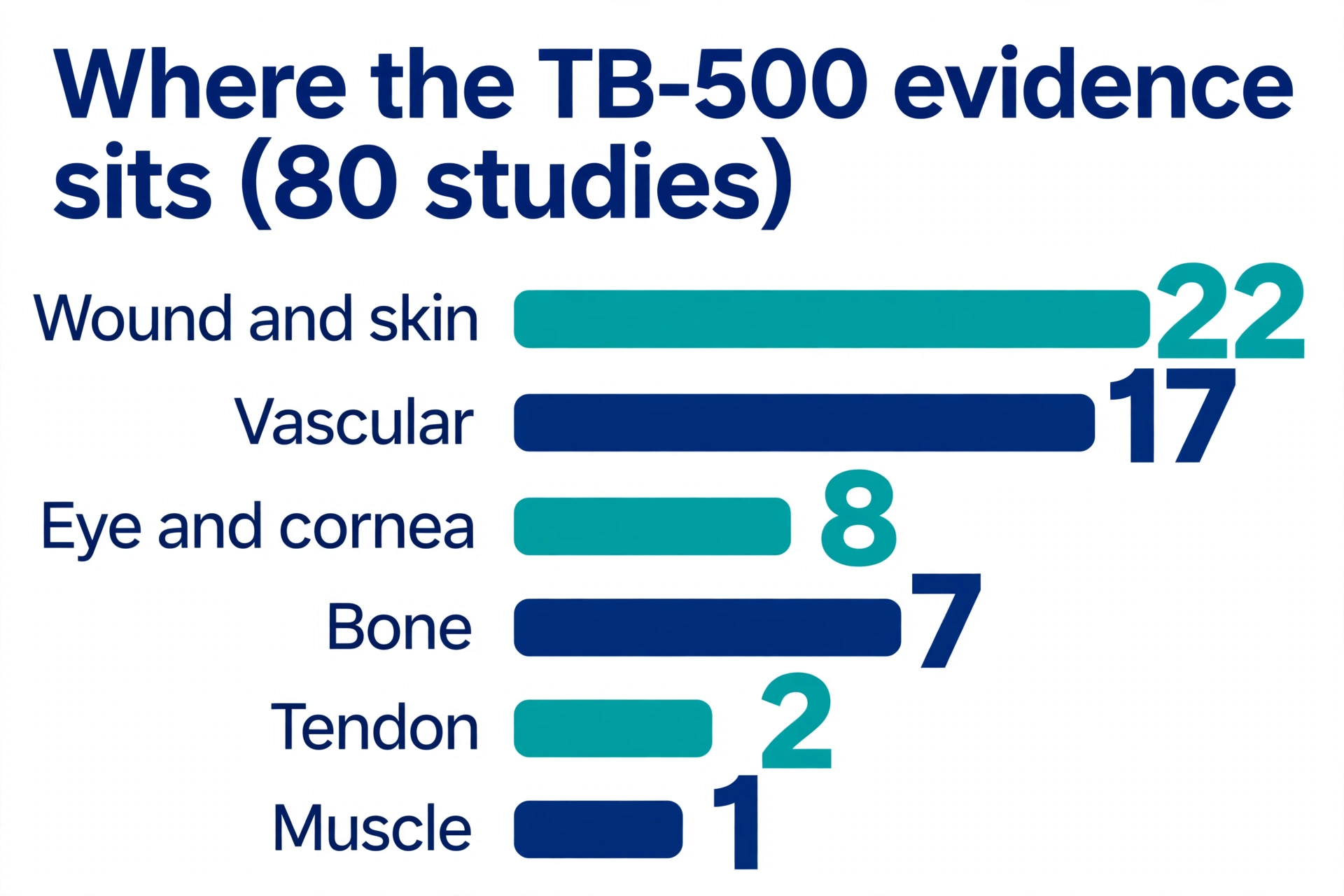
Now the TB-500 side, where the numbers cut the other way. A 2026 scoping review searched PubMed, Europe PMC and ClinicalTrials.gov through March 2026 and identified 1,772 records, of which 80 studies were included. Most of those studies evaluated TB4 itself (70 of 80, or 87.5%); only one study, 1.3% of the total, directly evaluated TB-500. Human evidence clustered in eye and wound settings, while the tissues athletes care about were almost empty: tendon accounted for just 2 of the 80 studies and muscle for just 1. That distribution is the single most useful fact in this whole comparison, because it shows that popularity and evidence point in different directions for TB-500.
Where the TB4 and TB-500 evidence actually sits
| Tissue studied | Studies (of 80) | Share |
|---|---|---|
| Wound, skin and soft tissue | 22 | 27.5% |
| Vascular and endothelial | 17 | 21.3% |
| Eye and cornea | 8 | 10.0% |
| Bone | 7 | 8.8% |
| Tendon | 2 | 2.5% |
| Muscle | 1 | 1.3% |
The table above is the data behind the chart below: a map of what has been studied, not a ranking of what works. A tissue with few studies is not proven ineffective, but it is also not a place where anyone can honestly claim strong support.
Studies by tissue in the 2026 TB4 and TB-500 scoping review (80 studies included from 1,772 records). Source: McGuire et al. (2026).
What about taking both?
The combination, often nicknamed the “Wolverine stack” online, is the most common follow-up question, and it has the weakest answer: no published trial, preclinical or human, has tested BPC-157 plus TB-500 together. The logic for stacking is plausible on paper, since the two mechanisms differ, but plausibility is not evidence, and combining two unapproved compounds also combines their unknowns, including purity, dosing and interaction risks. Our earlier guide to BPC-157 and TB-500 therapeutic uses covers the general background; the stack remains an extrapolation, not a studied protocol.
Safety, quality and sport rules
Both compounds are unapproved as medicines, which creates a practical problem that has nothing to do with biology: product quality. Reviews warn that unregulated manufacturing brings contamination and mislabelling risks, and the U.S. Food and Drug Administration lists the TB4 fragment among bulk substances that may present significant safety risks in compounding because human exposure and safety data are so limited. Third-party lab testing, sterile technique, and refusing any product that arrives cloudy, damaged or mislabelled are basic harm-reduction steps, not optional extras.
For athletes in tested sport, the rule is unambiguous and separate from the science: BPC-157 is prohibited as a non-approved substance, and WADA’s 2026 Prohibited List classifies TB4 and its derivatives, including TB-500, as prohibited. A short half-life is not a clearance window, and out-of-competition testing applies. Anyone subject to testing should check their federation’s rules first, and anyone with a diagnosed injury should see a clinician first: peptides are not a substitute for imaging, physiotherapy or load management. Get a proper diagnosis before experimenting, and talk to a doctor about pain that changes character, swelling, numbness or loss of function.
How to choose by injury type
For a tendon or ligament problem, the literature points to BPC-157 first, on the strength of its tendon-specific animal work, including the Chang tendon-outgrowth study. That is a relative statement: it means BPC-157 is the better-studied of the two for that tissue, not that it is proven to heal human tendons. For wound, skin or vascular healing, the TB4 literature is broader, though again mostly preclinical and mostly about TB4 rather than the TB-500 fragment itself. For a muscle strain, neither compound has a serious evidence base: one muscle study in the TB4 scoping review and a thin, animal-only BPC-157 muscle literature mean the honest answer is that rest, graded loading and physiotherapy carry the plan, with peptides at most an unproven adjunct.
Our BPC-157 dosage guide explains why no human dose can be stated with confidence, and our overview of peptides in performance puts both compounds in the wider recovery picture. If sterile preparation matters to your reading, the general peptide reconstitution guide covers the technique principles for any lyophilised peptide. Oxygen Anabolics publishes these comparisons so buyers can weigh evidence rather than marketing.
Frequently asked questions
Is TB-500 the same as thymosin beta-4?
No. Thymosin beta-4 is a 43-amino-acid protein found naturally in the body. TB-500 is a commercial product name for synthetic peptides marketed as related to TB4, built around its actin-binding region. Most published studies tested TB4 itself, so results from TB4 research cannot be assumed to apply identically to a TB-500 product.
Which one works faster?
No human study has compared onset of effect between the two, and no timeline can honestly be given. Animal healing curves do not convert into “you will feel better in X weeks” claims, and any seller promising a recovery date is selling marketing, not evidence.
Can I take BPC-157 and TB-500 together?
The combination has never been tested in a published trial. The mechanisms are complementary on paper, but stacking two unapproved compounds combines their quality and safety unknowns. If you are considering it, the decision belongs with a clinician who knows your injury, not with a forum thread.
Are BPC-157 and TB-500 legal, and can tested athletes use them?
Neither is an approved medicine, and both are prohibited in WADA-governed sport: BPC-157 as a non-approved substance and TB4 derivatives including TB-500 under the 2026 Prohibited List. Tested athletes should treat both as banned at all times, regardless of timing or dose.
Disclaimer: This article is educational information from the Oxygen Anabolics team, not medical advice. BPC-157 and TB-500 are investigational, unapproved compounds with no established human dosing for injury recovery. Do not use this content to diagnose or treat an injury. See a qualified clinician for diagnosis, and seek urgent care for severe pain, deformity, numbness, loss of function, or any symptom that worsens.
References
- McGuire et al. (2025). Regeneration or Risk? A Narrative Review of BPC-157 for Musculoskeletal Healing. Current Reviews in Musculoskeletal Medicine. PMID 40789979.
- Vasireddi et al. (2025). Emerging Use of BPC-157 in Orthopaedic Sports Medicine: A Systematic Review. HSS Journal. PMID 40756949.
- Chang, C.-H., et al. (2011). The promoting effect of pentadecapeptide BPC 157 on tendon healing involves tendon outgrowth, cell survival, and cell migration. Journal of Applied Physiology. PMID 21030672.
- McGuire et al. (2026). Thymosin Beta-4 and TB-500 in Tissue Healing, Regeneration, and Musculoskeletal Repair: A Scoping Review. Applied Sciences. Published 19 June 2026.