

Blog
Retatrutide Results: How Much Weight Loss Did TRIUMPH-1 Actually Show?

In TRIUMPH-1, the first large Phase 3 trial of retatrutide, adults with obesity who received the top dose of 12 mg once weekly lost an average of 25.0% of their body weight over 80 weeks when everyone randomised was counted, versus 3.9% on placebo. Counting only those who stayed on treatment, it reached 28.3% — the largest average loss ever reported in a Phase 3 obesity trial. The trial enrolled 2,339 adults and was published in the New England Journal of Medicine on 29 September 2026.
That headline needs its context: retatrutide is still an investigational medicine, approved nowhere in the world, and the 28.3% figure and the 25.0% figure answer two different questions. This guide walks through the dose-by-dose results, why two numbers circulate, how the findings compare with the other drugs in the class, and what the trials showed on side effects. Everything below is educational information, not medical advice: retatrutide cannot be prescribed today, and anyone considering a weight-loss medicine should talk to a doctor first. Our team at Oxygen Anabolics online pharmacy publishes these guides so readers can judge trial claims against the published evidence, not headlines.
What Retatrutide Is
Retatrutide (development code LY3437943) is a once-weekly injectable peptide developed by Eli Lilly that activates three hormone receptors at once: GLP-1, GIP, and glucagon. Semaglutide activates GLP-1 alone; tirzepatide activates GLP-1 and GIP. Retatrutide adds the glucagon receptor, which is meant to raise energy expenditure alongside appetite suppression. The trial data below are the first large-scale test of whether three mechanisms beat one or two.
The compound is sold in research form as Retatrutide 10 mg vials for laboratory research use only; no dose is approved for human use anywhere.
TRIUMPH-1 Results by Dose
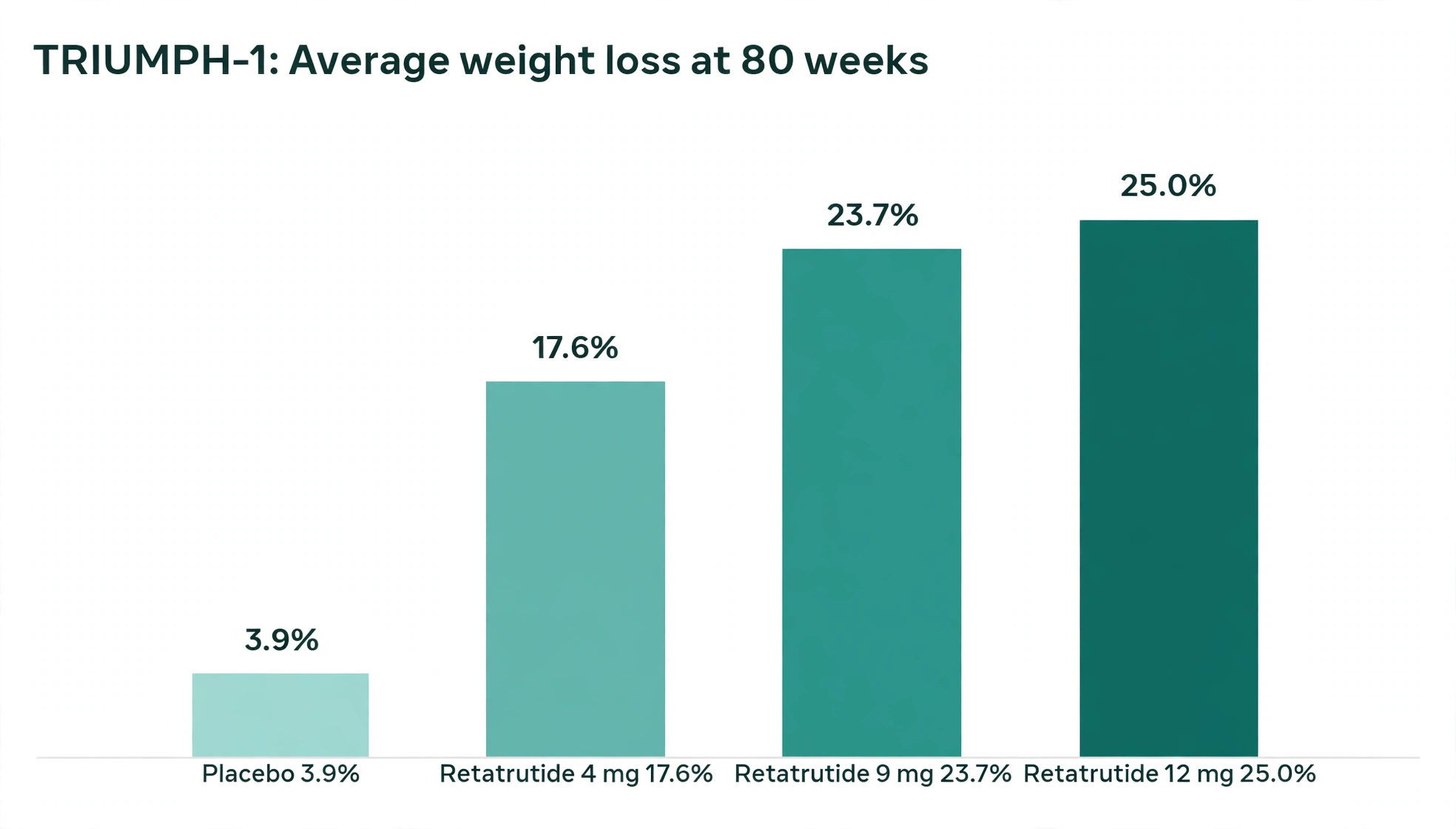
TRIUMPH-1 (NCT05929066) randomised 2,339 adults with obesity, or overweight with a weight-related condition, and without type 2 diabetes, to weekly retatrutide 4, 9, or 12 mg, or placebo, for 80 weeks. The table shows mean weight change at 80 weeks under both counting methods.
| Arm | Mean weight change, all randomised (treatment-regimen estimand) | Mean weight change, stayed on treatment (efficacy estimand) |
|---|---|---|
| Placebo | −3.9% | −2.2% |
| Retatrutide 4 mg | −17.6% | −19.0% |
| Retatrutide 9 mg | −23.7% | −25.9% |
| Retatrutide 12 mg | −25.0% | −28.3% |
The dose response is clear: every step up produced more weight loss, and the gap between 9 mg and 12 mg was smaller than the gap between 4 mg and 9 mg, the usual pattern near a drug’s ceiling. On the top dose, 45.3% of those who stayed on treatment lost at least 30% of their body weight — a level previously seen mainly after bariatric surgery. In a blinded extension for participants with a BMI of 35 or higher, average loss on 12 mg reached 30.3% (about 85 lbs) by 104 weeks.
TRIUMPH-1: average weight loss at 80 weeks (all randomised)
Source: Jastreboff et al., NEJM 2026 (TRIUMPH-1). Treatment-regimen estimand.
Why Two Different Numbers Circulate for the Same Trial
If you have seen both 25.0% and 28.3% quoted for the 12 mg dose, neither figure is wrong — they count different groups. The treatment-regimen estimand (25.0%) counts everyone who was randomised, including those who stopped the drug. The NEJM paper reports this as its main result.
The efficacy estimand (28.3%) counts only the effect in people who stayed on treatment as planned. Eli Lilly led its May 2026 press release with this figure, which answers a different question: “how much weight does the drug itself remove when it is actually taken?” Whenever you compare trials, check both numbers use the same counting method — mixing them inflates the gap.
How Long the Weight Loss Took
Weight loss had not levelled off by 80 weeks: in the extension, participants with a BMI of 35 or higher averaged 30.3% by 104 weeks. The earlier Phase 2 trial shows the same shape on a shorter clock. In the 48-week study of 338 adults, the 12 mg group had lost 17.5% by week 24 and 24.2% by week 48, against 2.1% on placebo. On 12 mg, everyone lost at least 5%, 93% lost at least 10%, and 83% at least 15%.
The 80-week figures are not a final plateau, and no published trial has followed users long after stopping — regain after stopping GLP-1 medicines is well documented.

TRIUMPH-2: Results in People With Type 2 Diabetes
TRIUMPH-2 tested the same three doses in 1,152 adults with obesity and type 2 diabetes over 80 weeks, published in The Lancet the same day as TRIUMPH-1. Weight loss was smaller than in people without diabetes, but large: 11.9% on 4 mg, 16.8% on 9 mg, and 18.8% on 12 mg, against 5.1% on placebo, counting everyone randomised.
HbA1c fell by 1.4 to 1.5 percentage points more than placebo, and about one in three participants on treatment lost at least 25% of their body weight. The earlier Phase 2 diabetes trial (Rosenstock et al., The Lancet 2023) had already shown the same direction: in 281 adults, retatrutide 12 mg lowered HbA1c by 2.02 percentage points at 24 weeks, against 0.01 on placebo and 1.41 on dulaglutide 1.5 mg.
How Retatrutide Compares With Tirzepatide and Semaglutide
The table below puts the three leading drugs side by side, all in adults with obesity and no diabetes — but read the warning under it first. These are separate trials in different people, not a head-to-head comparison. The direct comparison trial, TRIUMPH-5, has not reported yet, so no one can say which drug works better in the same person.
| Drug and trial | Top dose | Duration | Mean weight loss, all randomised |
|---|---|---|---|
| Retatrutide (TRIUMPH-1) | 12 mg weekly | 80 weeks | −25.0% (placebo −3.9%) |
| Tirzepatide (SURMOUNT-1) | 15 mg weekly | 72 weeks | −20.9% (placebo −3.1%) |
| Semaglutide 7.2 mg (STEP UP) | 7.2 mg weekly | 72 weeks | −18.7% (placebo −3.9%) |
On the numbers as published, retatrutide’s top dose produced about four percentage points more average loss than tirzepatide’s top dose and about six more than the high dose of semaglutide — but the trials ran for different lengths and retatrutide’s curve was still falling at 80 weeks. The gap may narrow, hold, or widen in a direct comparison. The table shows the order of magnitude fairly: all three drugs produce double-digit average loss, and retatrutide’s Phase 3 result is the largest yet reported. See our retatrutide vs tirzepatide comparison and our tirzepatide and semaglutide guides for the pairwise detail.
Side Effects and Safety: What the Trials Showed
The most common side effects in the retatrutide trials were gastrointestinal — nausea, diarrhoea, vomiting, constipation, and reduced appetite — mostly mild to moderate and more frequent at higher doses, the same profile as the approved GLP-1 medicines. In the Phase 2 obesity trial, heart rate rose in a dose-related way, peaked around week 24, and then declined. That pattern matters for long-term cardiovascular safety, which the ongoing TRIUMPH-Outcomes trial (NCT06383390) is designed to test.
Two points matter for anyone reading trial results as a buyer’s guide. First, the people in these trials were screened, monitored, and dose-escalated slowly over months under medical supervision; the side-effect profile of a research chemical bought online and self-administered is not the trial profile. Second, retatrutide is unapproved, so no regulator has reviewed its manufacturing quality, its long-term safety, or its labelling. Severe vomiting, gallbladder symptoms, or pancreatitis symptoms while using any GLP-1-type compound need prompt medical care — and tell the clinician exactly what you took.
What Is Still Unknown
Four gaps should temper the excitement. Approval: Lilly plans to file with the US FDA in early 2027, so no decision before late 2027 — and approval is never guaranteed. Long-term outcomes: no trial has yet shown whether retatrutide reduces heart attacks, strokes, or deaths; TRIUMPH-Outcomes is still running, and TRIUMPH-5, the direct trial against tirzepatide, has not reported. Muscle loss and regain: the papers report total body weight, not body composition, so how much of the loss is fat versus lean tissue is not yet established — a real concern for anyone training while using a weight-loss drug. Our retatrutide reconstitution and dosage guide stresses that research compounds are not a substitute for diet, resistance training, and medical supervision. Our GLP-1 peptides category collects the rest of our coverage of this drug family.
Frequently Asked Questions
How much weight did people lose on retatrutide in TRIUMPH-1?
On 12 mg, the average loss at 80 weeks was 25.0% counting everyone randomised and 28.3% counting only those who stayed on treatment. The 9 mg dose averaged 23.7% and 4 mg averaged 17.6%, against 3.9% on placebo.
Is retatrutide approved for weight loss?
No. As of November 2026 it is approved nowhere — not by the FDA, the EMA, or Health Canada. Lilly plans to file with the FDA in the first quarter of 2027. Until then it is available only inside clinical trials and as a research compound.
How does retatrutide compare with tirzepatide (Mounjaro/Zepbound)?
In separate Phase 3 trials, retatrutide 12 mg averaged 25.0% at 80 weeks and tirzepatide 15 mg averaged 20.9% at 72 weeks. That is not a head-to-head result. The direct trial, TRIUMPH-5, has not reported yet.
What are the most common side effects of retatrutide?
Gastrointestinal effects — nausea, diarrhoea, vomiting, constipation, and reduced appetite — were the most common in the trials, mostly mild to moderate and more frequent at higher doses. Heart rate rose in a dose-related way in Phase 2, peaking around week 24. Long-term cardiovascular safety is still being studied.
References
- Jastreboff AM, Kaplan LM, Davies MJ, et al.; TRIUMPH-1 Investigators. Retatrutide, a triple hormone receptor agonist, for treatment of obesity. N Engl J Med. 2026. doi:10.1056/NEJMoa2604169. PMID: 42814954.
- Bellido V, le Roux CW, Ekinci EI, et al. Retatrutide in adults with obesity and type 2 diabetes (TRIUMPH-2): a double-blind, parallel-group, randomised, placebo-controlled, phase 3 trial. Lancet. 2026;408(10563):1455–1472. doi:10.1016/S0140-6736(26)01861-1. PMID: 42810372.
- Jastreboff AM, Kaplan LM, Frías JP, et al. Triple-hormone-receptor agonist retatrutide for obesity — a phase 2 trial. N Engl J Med. 2023;389(6):514–526. doi:10.1056/NEJMoa2301972. PMID: 37366315.
- Rosenstock J, Frias J, Jastreboff AM, et al. Retatrutide, a GIP, GLP-1 and glucagon receptor agonist, for people with type 2 diabetes: a randomised, double-blind, placebo and active-controlled phase 2 trial. Lancet. 2023;402(10401):529–544. doi:10.1016/S0140-6736(23)01053-X. PMID: 37385280.
Disclaimer: This article is educational information only and is not medical advice. Retatrutide is an investigational compound not approved for human use by the FDA, the EMA, or Health Canada. Research peptides sold by Oxygen Anabolics are for laboratory research use only. Consult a qualified healthcare professional before starting, stopping, or changing any medication or weight-loss treatment, and seek prompt medical care for severe or worrying symptoms.