

Blog
HGH Dosage Guide: How Many IU by Goal, and What Studies Show

The short answer to “how much HGH should I take?” is that there is no single approved performance dose — and the clinical doses used in medicine are much smaller than the numbers usually quoted online. In adult growth hormone deficiency, treatment starts low, typically 0.1 to 0.5 mg per day depending on age, and is titrated against IGF-1 levels, side effects and blood glucose. Converted at the standard 3 IU per milligram of somatropin, that is roughly 0.3 to 1.5 IU per day. Everything above that range is outside approved replacement dosing, and the higher the dose, the more likely the fluid retention, joint stiffness and glucose changes described below.
This guide explains HGH dosage in both IU and milligrams, shows how the clinical starting doses break down by age, and separates what trials demonstrated from what gym lore promises. It is educational information, not medical advice: growth hormone affects glucose metabolism and fluid balance, so anyone considering it should first speak with a doctor and get baseline bloodwork. Oxygen Anabolics publishes these guides so readers can judge claims against evidence rather than marketing.
IU vs Milligrams: The Conversion You Need First
HGH is labelled in two different units, which is where much of the confusion starts. Pharmaceutical somatropin is dosed in milligrams, while most online discussion uses international units (IU). The internationally agreed specific activity of somatropin is 3 IU per milligram, so 1 mg equals 3 IU and 1 IU equals about 0.33 mg. A 120 IU kit therefore contains about 40 mg of somatropin in total, and a 240 IU kit about 80 mg — but the total in a kit says nothing about the right daily dose, which depends on the individual, the indication and the monitoring in place.
That conversion also explains why a “small” sounding dose in milligrams is not small at all. A daily dose of 0.5 mg is 1.5 IU; a daily dose of 2 mg is 6 IU. When you see a dose quoted online, convert it before comparing it with the clinical table below — many apparently modest numbers are several times the replacement range. Readers comparing products can start with the OptiTropin HGH 120 IU kit listing to see how a kit total is presented, remembering that kit size is a supply quantity, not a dosing recommendation.
HGH Starting Doses by Age: What the Guidelines Say
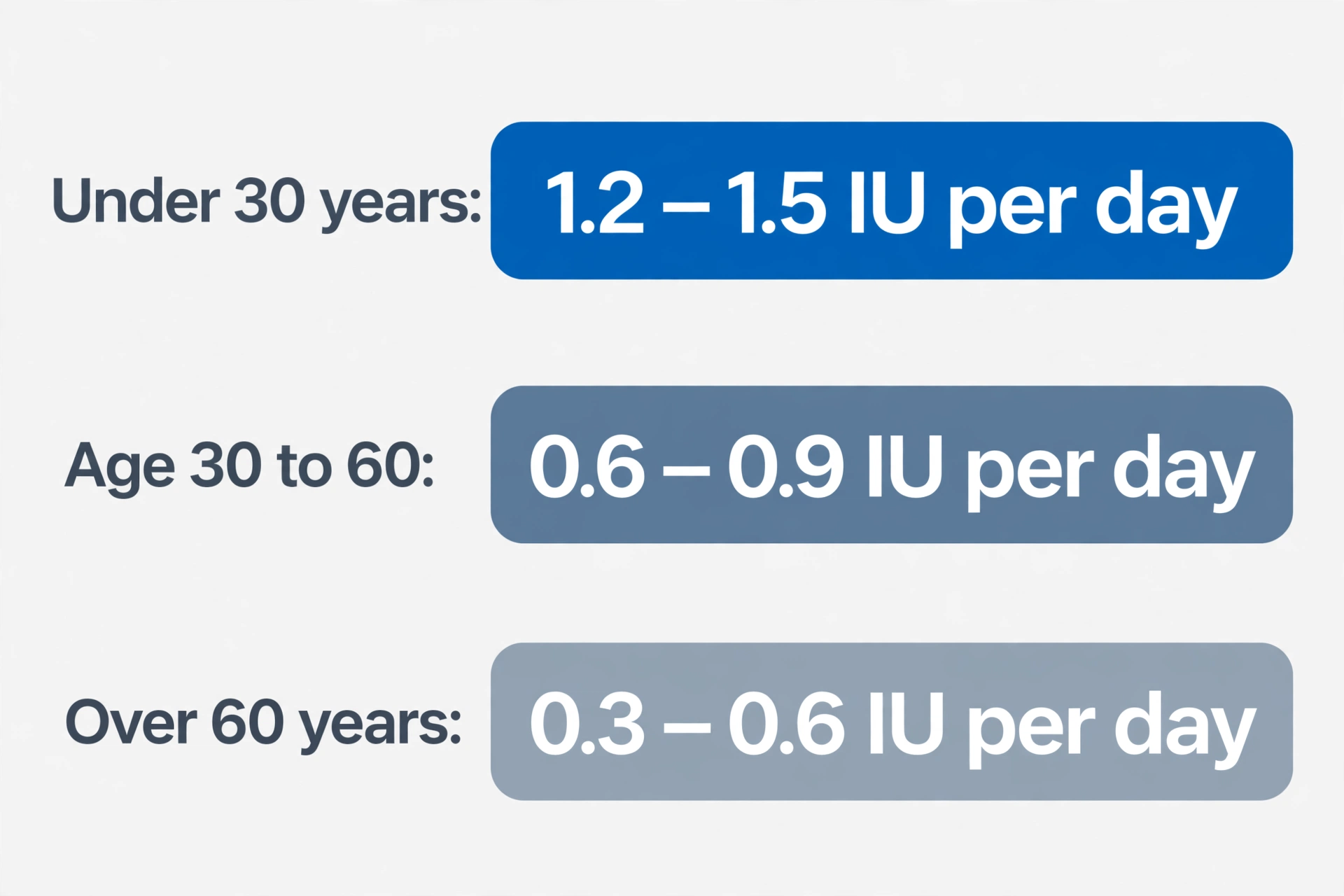
The Endocrine Society guideline for adult growth hormone deficiency recommends starting low and increasing slowly, with older patients starting lower and titrating more gradually, and younger patients sometimes starting higher. The American Association of Clinical Endocrinologists gives the same pattern in concrete age bands, and the table below converts those milligram starting doses into IU using the 3 IU per milligram standard.
| Age group | Clinical starting dose (mg/day) | Same dose in IU/day | Titration note |
|---|---|---|---|
| Under 30 years | 0.4–0.5 | 1.2–1.5 | Highest starting range; transition patients may need more |
| Age 30–60 years | 0.2–0.3 | 0.6–0.9 | Increase by 0.1–0.2 mg/day at 1–2 month intervals if tolerated |
| Over 60 years | 0.1–0.2 | 0.3–0.6 | Lowest starting range; slower titration, closer glucose monitoring |
The goal of clinical titration is an IGF-1 level in the middle of the age- and sex-appropriate normal range, without unacceptable side effects — not the highest IGF-1 achievable. Doses are adjusted in small steps, typically 0.1–0.2 mg per day, and reviewed after several weeks, because benefits may not become apparent for six months or more of treatment, while side effects can appear much sooner.
Clinical starting doses by age (midpoint of each range, IU per day)
1.35 IU
0.75 IU
0.45 IU
Bars show each range’s midpoint; the ranges are what the guidelines publish.
Dosage by Goal: Replacement, Recovery and Performance Claims
For diagnosed adult growth hormone deficiency, the goal is replacement: restore IGF-1 toward normal, improve body composition modestly, and keep side effects acceptable. That is the only setting in which the doses above are established. For general “anti-aging,” recovery or physique goals in people without deficiency, there is no approved dosing schedule at all, and the trials in healthy older adults are a cautionary tale rather than an endorsement.
In Rudman’s classic 1990 trial, 12 healthy men aged 61 to 81 received about 0.03 mg per kilogram three times a week for six months. Lean body mass rose 8.8% and adipose tissue mass fell 14.4%, while lumbar spine bone density rose 1.6%. Those numbers are still quoted in marketing today — usually without the rest of the story. In Papadakis and colleagues’ double-blind trial of 52 healthy men aged 70 to 85, the same style of dosing raised lean mass by 4.3% and cut fat mass by 13.1% over six months, but produced no significant improvement in knee or hand-grip strength or in systemic endurance, and 26% of the growth hormone recipients needed a dose reduction because of side effects, against none on placebo.
The honest summary is therefore narrow: growth hormone can shift body composition measurably over months, but in healthy older adults it did not make people stronger or fitter in controlled testing, and side effects forced dose cuts in a quarter of recipients. Anyone selling a dose as a shortcut to strength is going beyond what these trials showed.

Timing, Frequency and Duration
Clinical somatropin is injected under the skin, usually once daily in the evening to mimic the body’s natural nighttime secretion pattern. The hormone clears within hours, but its mediator IGF-1 stays elevated much longer, which is why once-daily dosing is standard. Community “5 days on, 2 days off” or split-dosing patterns lack comparable trial support, and skipping days does not remove the need for monitoring.
Duration matters as much as dose. The trials above ran for six months, and the guideline notes benefits may not become apparent for six months or more. Short bursts are unlikely to reproduce trial results, while longer use increases cumulative exposure to glucose and fluid-balance effects — one reason a doctor’s supervision, with IGF-1, fasting glucose and thyroid checks, is part of legitimate treatment. Note that the HGH 240 IU product is simply a larger total supply; a larger kit never justifies a larger daily dose.
Side Effects and Bloodwork: What to Watch
The most common side effects in the Endocrine Society guideline are related to fluid retention — swelling of the hands and feet, joint stiffness, muscle aches and tingling or numbness — occurring in 5–18% of treated patients, with carpal tunnel syndrome in approximately 2%. Most of these reactions improve when the dose is reduced, which is exactly why guidelines insist on starting low and increasing slowly. Rising fasting glucose is the other key concern: growth hormone opposes insulin action, so people with diabetes, prediabetes or a family history of diabetes need lower starting doses and closer glucose monitoring, and should discuss the risk with a doctor before any use.
A sensible bloodwork panel before and during any medically supervised course includes IGF-1 (the titration target), fasting glucose and HbA1c, thyroid hormones and a lipid profile. Seek prompt medical care for persistent hand numbness or weakness, marked swelling, severe headache, vision changes or persistently high blood sugar. Sterile technique, correct storage and never sharing injection equipment are basic harm-reduction requirements for any injectable.
Statistics at a Glance
- 8.8% lean mass gain, 14.4% fat mass loss: Rudman et al. (1990), 12 healthy men aged 61–81, six months of growth hormone — with no strength testing in that trial.
- 4.3% lean mass gain, 13.1% fat mass loss, no strength gain: Papadakis et al. (1996), 52 healthy men aged 70–85, six months, double-blind and placebo-controlled.
- 26% needed a dose reduction: Papadakis et al. (1996) — 26% of growth hormone recipients vs 0% on placebo, after 48 side-effect incidents vs 14 on placebo.
- 5–18% fluid-retention effects, ~2% carpal tunnel: rates reported in the Endocrine Society guideline for treated adults with growth hormone deficiency.
Frequently Asked Questions
How many IU is 1 mg of HGH?
1 mg of somatropin equals 3 IU, so 1 IU is about 0.33 mg. A clinical starting dose of 0.2 mg per day is therefore 0.6 IU per day, and 0.5 mg per day is 1.5 IU per day.
What is a normal starting HGH dose?
For adult growth hormone deficiency, guidelines start low by age: 0.4–0.5 mg (1.2–1.5 IU) per day under 30, 0.2–0.3 mg (0.6–0.9 IU) at 30–60, and 0.1–0.2 mg (0.3–0.6 IU) over 60, titrated against IGF-1 and side effects. No starting dose is established for healthy people seeking performance or anti-aging effects.
How long does HGH take to work?
Body-composition changes were measured after six months, and guidelines note benefits may not become apparent for six months or more. Strength and endurance did not improve in the Papadakis trial despite those changes.
Is a higher HGH dose better?
Not according to the evidence: higher doses in the early trials produced more fluid retention, joint problems and glucose rises, and Papadakis found dose reductions necessary in 26% of recipients. Clinical practice titrates to the lowest dose that normalises IGF-1 without side effects.
Disclaimer
This article is educational information only and is not medical advice. Growth hormone is a prescription medicine in Canada, and use outside medical supervision can cause fluid retention, carpal tunnel symptoms, glucose intolerance and other harms. Do not start, stop or change a hormone dose based on this article — discuss your situation, bloodwork and risks with a qualified clinician, and seek care promptly for severe swelling, hand weakness, persistent headache, vision changes or very high blood sugar.
For the broader picture, see our guides on human growth hormone benefits, testosterone and HGH together, where to buy HGH in Canada and HGH benefits and uses. The full HGH category lists the products this guide’s dosing discussion relates to.
References
- Molitch ME, Clemmons DR, Malozowski S, Merriam GR, Vance ML. Evaluation and treatment of adult growth hormone deficiency: an Endocrine Society clinical practice guideline. Journal of Clinical Endocrinology & Metabolism. 2011;96(6):1587–1609.
- Rudman D, Feller AG, Nagraj HS, et al. Effects of human growth hormone in men over 60 years old. New England Journal of Medicine. 1990;323(1):1–6.
- Papadakis MA, Grady D, Black D, et al. Growth hormone replacement in healthy older men improves body composition but not functional ability. Annals of Internal Medicine. 1996;124(8):708–716.
- American Association of Clinical Endocrinologists. Medical guidelines for clinical practice for growth hormone use in growth hormone-deficient adults and transition patients — 2009 update. Endocrine Practice. 2009;15(Suppl 2).