

Blog
Testosterone Enanthate Cycle Guide: Dosage by Goal, Cycle Length, AI Use & PCT Timing

A testosterone enanthate cycle is most commonly structured at 300 to 500 mg per week, split into two injections, for 12 to 16 weeks, with post-cycle therapy (PCT) starting about two weeks after the last injection. That is the pattern you will see repeated across practice — but it is a pattern, not a prescription: no dose of testosterone is approved for bodybuilding, and the only controlled data come from clinical studies that used fixed doses under supervision. This guide explains what those studies measured, how cycle length and injection timing follow from the ester’s 4.5-day half-life, when an aromatase inhibitor (AI) is warranted, and when PCT should begin.
Everything below is educational information, not medical advice. Testosterone is a prescription medicine in Canada, and anyone using it should be under a doctor’s care with regular bloodwork. Our team at OxygenPharm publishes these guides so readers can judge claims against evidence rather than marketing.
What a Testosterone Enanthate Cycle Is
A cycle means a defined period of testosterone use, followed by a defined period off, with PCT in between to help the body’s own production restart. Enanthate is the long-ester form of testosterone: the same hormone as in every other ester, released slowly from an oily depot in the muscle. Its half-life is about 4.5 days, so levels peak within 8 to 24 hours of an injection and fall to baseline by roughly day 9 after a single dose. Our testosterone enanthate half-life guide works through those numbers in full.
The standard preparation is Testosterone Enanthate at 250 mg per millilitre: 500 mg a week is 2 mL a week, split into two 1 mL injections, so a 10 mL vial lasts five weeks at that dose.
Dosage by Goal: What Is Commonly Reported, and What the Evidence Says
There is no established human dose of testosterone enanthate for physique goals. The ranges below are the ones most commonly reported in practice, each anchored to the nearest controlled evidence.
| Goal | Commonly reported weekly dose | Typical cycle length | What the evidence anchors |
|---|---|---|---|
| Testosterone replacement range | 100–150 mg | Ongoing, under a doctor | 125 mg/week restored near-baseline levels (Bhasin 2001) |
| First cycle, lean mass | 300–500 mg | 12 weeks | 300 mg/week added 5.2 kg fat-free mass in 20 weeks (Bhasin 2001) |
| Mass-focused cycle | 500–600 mg | 12–16 weeks | 600 mg/week added 7.9 kg in 20 weeks; 6.1 kg in 10 weeks with training (Bhasin 1996) |
Two things stand out. First, the gains are dose-dependent but not linear: doubling the dose from 300 to 600 mg bought about 2.7 kg more fat-free mass over 20 weeks, while the side-effect load — rising hematocrit, falling HDL cholesterol — climbed with it. Second, doses above 600 mg a week were not tested in the best dose-response study we have, so anything above that range is unmapped: no measured benefit, only rising risk.
| Weekly testosterone enanthate dose | Average trough testosterone | Fat-free mass gained in 20 weeks |
|---|---|---|
| 125 mg | 542 ng/dL | +3.4 kg |
| 300 mg | 1,345 ng/dL | +5.2 kg |
| 600 mg | 2,370 ng/dL | +7.9 kg |
These men did not train during the study, and their own testosterone was first suppressed with a GnRH agonist — so the numbers isolate the drug’s effect, not a training program’s.

How Long Should the Cycle Last?
Twelve to sixteen weeks is the standard length for an enanthate cycle, and the reason is the half-life. With a 4.5-day half-life, it takes roughly four to five weeks for blood levels to reach a steady state, so a cycle shorter than eight weeks spends most of its length still climbing while still suppressing the body’s own production for weeks afterward. Longer is not automatically better either: every additional week extends suppression and exposure to side effects — elevated hematocrit, blood pressure, and cholesterol changes — while the marginal muscle gain per week falls. Our first testosterone cycle guide covers the same length question from the beginner’s side, including what to have in place before week one.
Injection Schedule: Why Twice a Week
Because the half-life is 4.5 days, a once-weekly injection leaves a wide gap: by day 7, about a third of the dose remains, so levels swing from a high peak to a deep trough. Splitting the same weekly dose into two injections — Monday and Thursday, or every three to four days — keeps the trough at roughly 60% of the peak. That steadier level is why twice-weekly dosing is the default, and it sets bloodwork timing: draw blood midway between injections to capture the trough.
Sterile technique is non-negotiable: a fresh needle and syringe for every injection, an alcohol swab, a clean site, and never sharing vials or needles. Rotate sites — glute and outer thigh are the usual choices — and seek medical attention for redness, swelling, or fever after an injection. The broader Injectable Steroids category lists the other long esters alongside enanthate.
AI Use on Cycle: When It Helps, and When It Hurts
Testosterone converts to estradiol through the aromatase enzyme, and estradiol rises with the dose. That is normal — estradiol supports libido, mood, and bone health — and the goal of an aromatase inhibitor (AI) such as anastrozole or exemestane is to keep estradiol in a healthy range, not to drive it to zero. Crashing estradiol causes joint pain, low libido, fatigue, and mood problems, and it is one of the most common self-inflicted mistakes on a first cycle.
The evidence-based approach is bloodwork-driven: baseline estradiol before the cycle, re-check around week four or five when levels have steadied, and use an AI only if estradiol is above range and symptoms — water retention, sensitive or swollen breast tissue, mood swings — are present. The post-cycle therapy (PCT) category carries the ancillaries used on and after a cycle, including the aromatase inhibitors and the SERMs discussed below.
What the Studies Show: Gains, and the Costs That Come With Them
The controlled evidence:
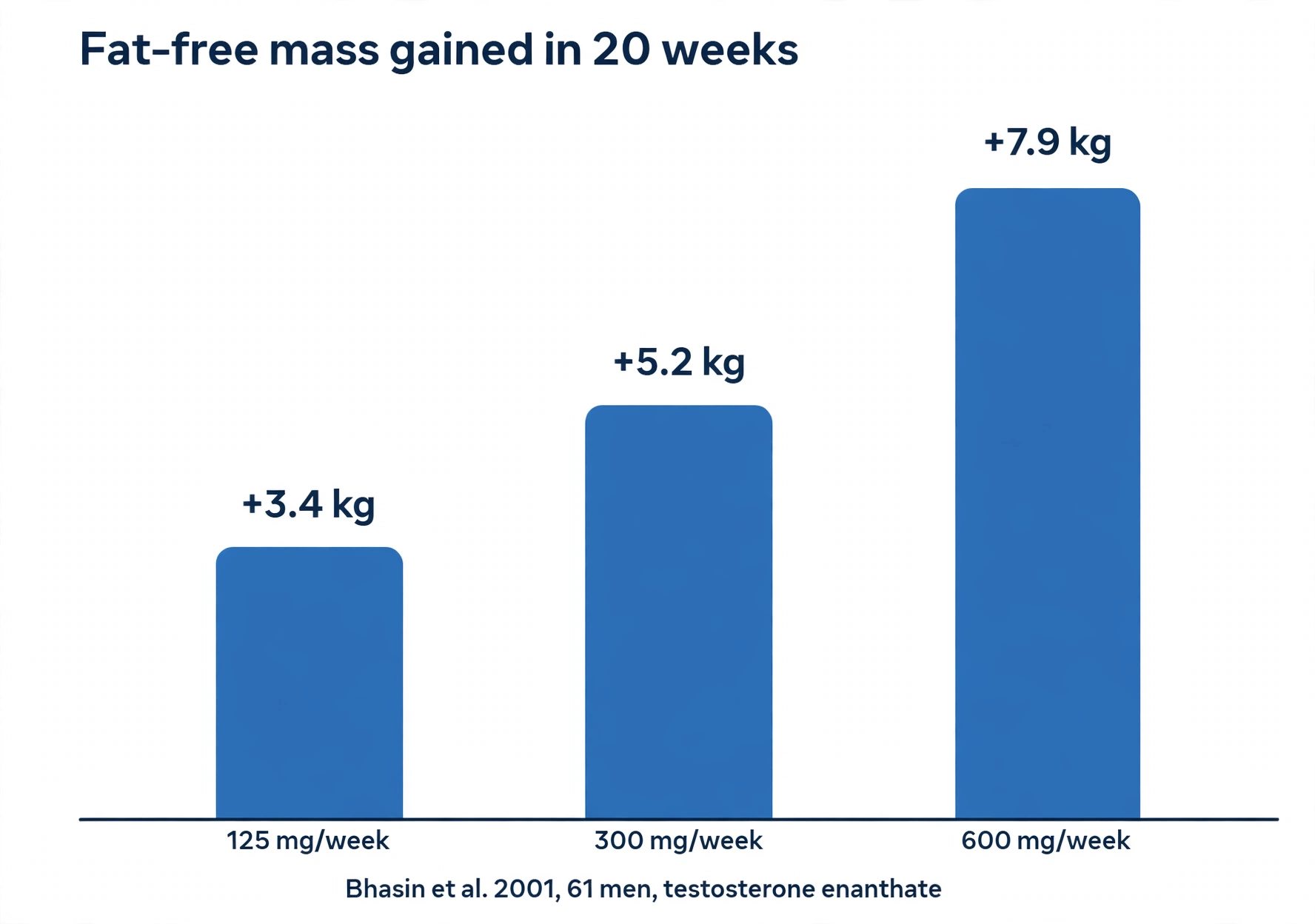
- Fat-free mass is dose-dependent. In 61 men aged 18 to 35, 20 weeks of testosterone enanthate produced +3.4 kg at 125 mg/week, +5.2 kg at 300 mg/week, and +7.9 kg at 600 mg/week — without any training (Bhasin 2001).
- Training multiplies the effect. The same 600 mg weekly dose with strength training for 10 weeks added 6.1 kg of fat-free mass, 22 kg to the bench press, and 38 kg to the squat (Bhasin 1996).
- Trough levels track the dose. Average trough testosterone was 542 ng/dL at 125 mg/week, 1,345 ng/dL at 300 mg/week, and 2,370 ng/dL at 600 mg/week (Bhasin 2001).
- Dependence is a real risk. A pooled analysis put anabolic steroid dependence at 32.5% (95% CI 25.4–39.7%) — roughly one in three users (Pope 2014).
- Hematocrit is the key safety marker. Guidance calls for stopping or reducing the dose when hematocrit rises above 54%, and for evaluating a PSA above 4 ng/mL (above 3 ng/mL with increased risk) (Bhasin 2018).
Fat-free mass gained in 20 weeks, by weekly dose (Bhasin 2001) — the bars repeat the table above.
125 mg/week — +3.4 kg
300 mg/week — +5.2 kg
600 mg/week — +7.9 kg
PCT Timing: When to Start, and What It Looks Like
PCT cannot start the day after the last injection, because enanthate is still releasing from the depot. The standard wait is about 14 days — roughly three half-lives, at which point about 12.5% of the final dose remains. Starting SERMs earlier means fighting testosterone that is still present; starting much later means extra weeks with low testosterone and no support. Our PCT timing guide lays out the wait for every injectable ester side by side.
The commonly reported PCT protocol after an enanthate cycle is a SERM — tamoxifen (Nolvadex) or clomiphene (Clomid) — taken daily for four weeks, with bloodwork four to six weeks after PCT ends to confirm that testosterone, LH, and FSH have recovered. What matters most is that PCT is planned before the cycle starts, not improvised in the final week.
Bloodwork and Safety Checklist
Before, during, and after a cycle, the bloodwork that matters is the set our testosterone bloodwork guide details: total and free testosterone, estradiol, LH and FSH, hematocrit and hemoglobin, a lipid panel, liver enzymes, and PSA for men over 40 or with risk factors. Draw a baseline before week one, repeat it around week five when levels have steadied, and again after PCT.
See a doctor promptly if hematocrit rises above 54%, if blood pressure stays elevated, if chest pain or shortness of breath appears, or if breast tissue changes develop. A cycle is a medical decision with a beginning, a middle, and a planned end — plan all three before the first injection.
Frequently Asked Questions
How long does a testosterone enanthate cycle last?
Most enanthate cycles run 12 to 16 weeks. It takes about four to five weeks for blood levels to reach a steady state.
What dose of testosterone enanthate is used for a first cycle?
The most commonly reported first-cycle range is 300 to 500 mg per week, split into two injections, for 12 weeks. In controlled studies, 300 mg a week added 5.2 kg of fat-free mass over 20 weeks in men who did not train. No dose is medically approved for physique use.
How often should I inject testosterone enanthate?
Twice a week — for example, Monday and Thursday — keeps levels steadiest, because the 4.5-day half-life means a weekly injection swings from a high peak to a deep trough. Draw bloodwork midway between injections to capture the trough.
When do I start PCT after a testosterone enanthate cycle?
About 14 days after the last injection, roughly three half-lives. Starting earlier means the SERM competes with testosterone still releasing from the depot; starting much later leaves extra weeks with low testosterone and no support.
References
- Bhasin S, Woodhouse L, Casaburi R, et al. Testosterone dose-response relationships in healthy young men. American Journal of Physiology – Endocrinology and Metabolism. 2001;281(6):E1172–E1181. PMID: 11701431.
- Bhasin S, Storer TW, Berman N, et al. The effects of supraphysiologic doses of testosterone on muscle size and strength in normal men. New England Journal of Medicine. 1996;335(1):1–7. PMID: 8637535.
- Pope HG Jr, Wood RI, Rogol A, et al. Adverse health consequences of performance-enhancing drugs: an Endocrine Society scientific statement. Endocrine Reviews. 2014;35(3):341–375. PMID: 24423981.
- Bhasin S, Brito JP, Cunningham GR, et al. Testosterone therapy in men with hypogonadism: an Endocrine Society clinical practice guideline. Journal of Clinical Endocrinology & Metabolism. 2018;103(5):1715–1744.
Disclaimer: This article is educational information, not medical advice. Testosterone enanthate is a prescription medicine in Canada. Anabolic steroid use carries serious health risks, including cardiovascular disease, liver injury, infertility, and dependence. Consult a qualified healthcare professional before any decision about hormone use.