

Blog
BPC-157 Side Effects & Safety: What Human Studies Actually Show

BPC-157 is one of the most talked-about recovery peptides, and one of the least tested in people. Search for its side effects and you will find long lists, confident reassurances, and dire warnings — but almost none of that comes from human studies, because they barely exist.
The direct answer: no side effects were reported in the three small human pilots to date, covering just 30 people, and no randomized, placebo-controlled trial in humans has been published. That does not mean BPC-157 is safe — its safety in humans is largely unmeasured, and anyone claiming a known side-effect rate is going beyond the evidence.
Educational information only, not medical advice. BPC-157 is not an approved medicine, and this article does not recommend its use. If you experience symptoms after using any peptide, or you have a medical condition, see a doctor promptly rather than adjusting anything on the basis of an article.
Why “no side effects reported” is not the same as “no side effects”
A study with 30 people and no control group can only detect problems that are common, immediate, and obvious. It cannot rule out uncommon reactions, delayed effects, interactions, or risks that appear only after months of use. The 2025 reviews are explicit: human data are extremely limited, the compound remains investigational, and its use should be approached with caution.
That distinction matters because BPC-157 is a 15-amino-acid synthetic peptide, originally studied as a fragment of a gastric-juice protein. Most of what is known comes from animal and laboratory work reporting tissue-repair and blood-vessel effects. Animal results are a reason to run proper human trials, not a safety record in people: a rat tendon study cannot tell you what a peptide will do to your liver, immune system, or an undiagnosed condition.
Our BPC-157 dosage guide explains why no validated human dose exists, and our BPC-157 vs TB-500 comparison sets out how the two peptides differ. This article answers a narrower question: what was observed, what is only theoretical, and when to seek medical care.
Every human study of BPC-157, in one table
For context, see the research peptides category. A 2025 systematic review screened 544 articles (1993–2024) and included 36 studies: 35 preclinical and only 1 clinical. It found no clinical safety data in humans. A second 2025 review agreed: only three pilot studies exist, none reported adverse effects, but rigorous large-scale trials are lacking. The three pilots below differ in condition, route, and setting, and none had a placebo group.
| Study | People | What was given | Adverse events reported | Key limitation |
|---|---|---|---|---|
| Knee pain, retrospective chart review (Lee & Padgett, 2021) | 16 | Injection into the joint; 12 received BPC-157 alone, 4 received it with thymosin beta-4 | None described | Retrospective, no control group, mixed knee diagnoses, phone follow-up |
| Interstitial cystitis pilot (Lee et al., 2024) | 12 women, aged 39 to 76 | Single 10 mg administration around the inflamed bladder area during one procedure | None reported; no one dropped out | Uncontrolled pilot, no placebo group; symptom scores only |
| Intravenous safety pilot (Lee & Burgess, 2025) | 2 healthy adults | 10 mg intravenously on day 1, then 20 mg on day 2, with bloodwork and vital signs over 3 days | None reported; no change in tested heart, liver, kidney, thyroid, or blood-glucose markers | Only 2 people, previously exposed to BPC-157, 3-day observation only |
Two cautions apply to all three reports: they share the same first author and were run in private clinics, and the bladder pilot’s headline result — 10 of 12 women reporting complete resolution, 2 reporting 80% success — comes from an uncontrolled study with no placebo group, so improvement cannot be separated from placebo response or natural recovery.

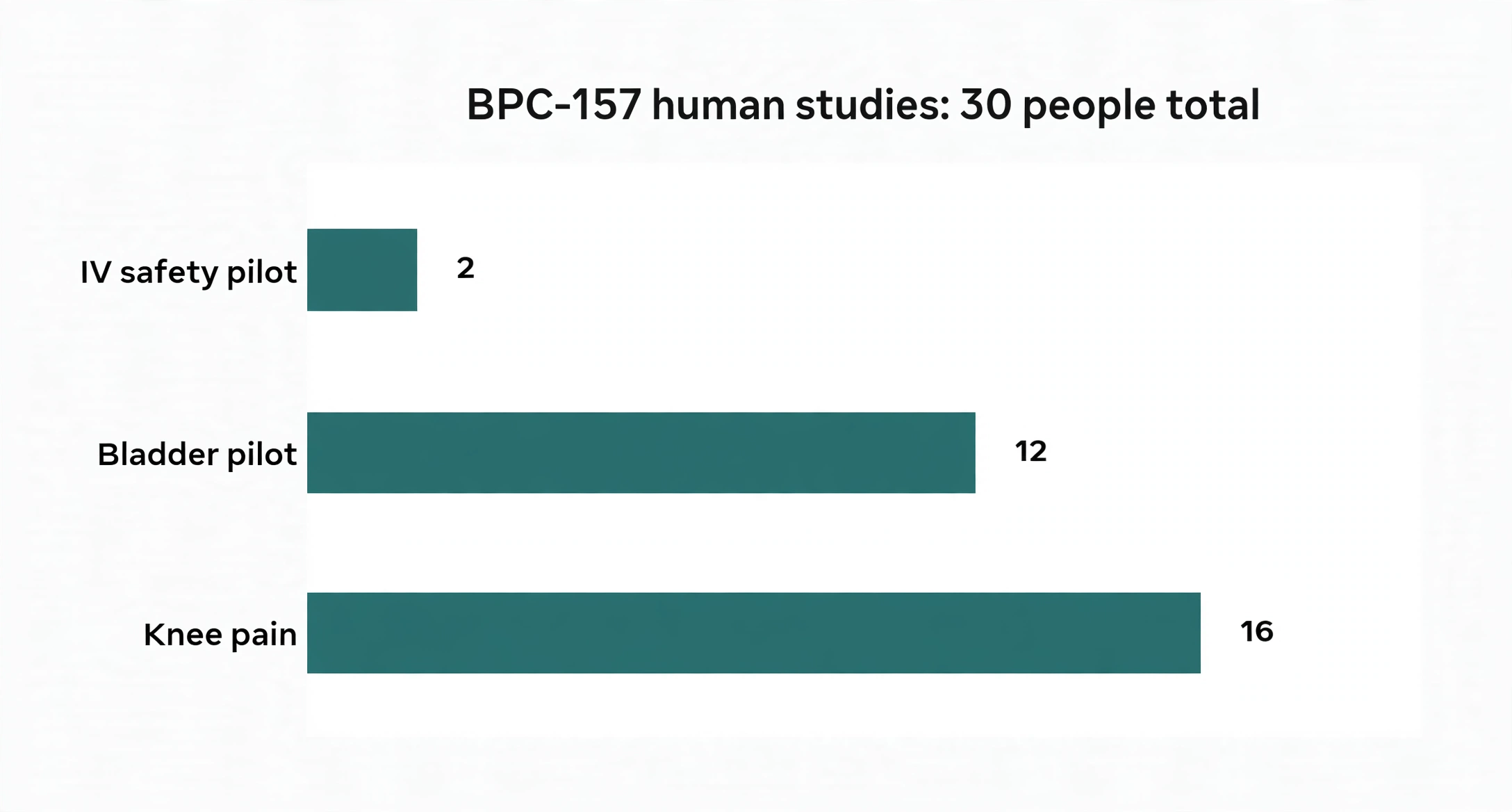
Figure: How small the human evidence base is — participants per pilot study
Knee pain chart review: 16 people
Bladder pilot: 12 people
Intravenous safety pilot: 2 people
Bars are scaled to the largest study (16 people = 100%). Total across all three pilots: 30 people. Source: McGuire et al., 2025, summarising the three pilot studies.
Reported, theoretical, and product-quality risks — kept apart
Most online lists mix three different kinds of risk, which is why they disagree so wildly. Keeping them apart gives a clearer picture.
| Kind of risk | Examples | Evidence status in humans |
|---|---|---|
| Reported in human pilots | None reported in the three pilots above | Observed in 30 people, uncontrolled, short follow-up — cannot rule out uncommon or delayed harms |
| Theoretical, from biology or animal work | Immune reaction to a foreign peptide; effects on blood-vessel growth pathways | Plausible concerns flagged by reviewers and regulators; not measured as a rate in humans |
| Product-quality risk | Impurities from peptide synthesis, inaccurate dose in the vial, contamination, loss of sterility | A property of unregulated supply, not of the molecule alone; no batch can be assumed pure without testing |
| Injection-procedure risk | Local pain, redness, or infection at the injection site | A known risk of any injection; sterile technique reduces it but does not remove it |
The theoretical rows matter even though they carry no number. A synthetic peptide injected into the body can, in principle, be recognised by the immune system — immunogenicity — and peptide synthesis can leave related impurities that behave differently from the intended molecule. None of this proves a reaction rate. It explains why “nothing was reported in 30 people” is weak reassurance: the studies were not designed, sized, or long enough to detect these problems. Likewise, preclinical studies reporting no adverse effects across several organ systems do not settle human safety, because animals in a controlled study receive a characterised substance at a known dose, while a buyer online faces a different product and dose history.
The risk most people underestimate: what is actually in the vial
For research-use peptides, product quality is often the largest controllable risk. A vial labelled with one peptide and dose may contain less or more than stated, related fragments, or contaminants from manufacture or handling. Without third-party testing of the specific batch — an independent certificate of analysis — a buyer cannot verify purity, identity, or dose from the label alone.
The BPC-157 5 mg vials listed by Oxygen Anabolics are research material, and the same rule applies: a label is a claim, and only independent testing verifies it. Sterile technique is the other half of this risk — any injectable handled without sterile practice can introduce bacteria regardless of the peptide itself. A cloudy vial, visible particles, or storage outside stated conditions means it should not be used, and fever, spreading redness, swelling, or pus at an injection site needs same-day medical care.
Who should be extra cautious, and when to see a doctor
Medical advice should come before any experimentation if you are pregnant or breastfeeding, have a history of cancer, an immune or autoimmune condition, liver or kidney disease, diabetes, a bleeding disorder, or take blood thinners or any prescription medicine — interactions have not been studied in humans. Athletes subject to anti-doping testing should check their sport’s rules first: unapproved peptides are routinely prohibited.
Seek care promptly for fever after an injection; spreading redness, warmth, swelling, or pain at an injection site; hives, swelling of the lips or face, or difficulty breathing; unusual bruising or bleeding; persistent nausea, abdominal pain, or yellowing of the skin or eyes; or any new symptom after first use that does not settle. If bloodwork is warranted, a baseline plus a repeat panel beats a single test after symptoms appear.
How to read online side-effect lists without being misled
If a list gives a precise frequency — for example, a percentage of users who experience a named symptom — ask where that number came from. For BPC-157, no human dataset is large enough to produce such a percentage, so any precise rate is borrowed from animal work, extrapolated from another peptide, or invented. Honest reporting looks like the table above: none observed in 30 people, plus theoretical and supply risks, with gaps stated plainly. The same test applies to testimonials: a recovery story is not a safety study, and an online horror story is not proof of causation, since the product and dose are usually unverified.
Our therapeutic-uses overview and TB-500 dosage guide apply the same discipline: what was studied, in whom, and what remains unknown.
Frequently asked questions
Does BPC-157 have side effects?
No side effects were reported in the three human pilots, but they covered only 30 people, had no control groups, and were short. That does not prove BPC-157 has no side effects — only that none were reported in a very small, uncontrolled sample.
Is BPC-157 safe for long-term use?
Long-term safety is unestablished: no large, long trials exist, so effects taking months or years to appear remain unknown. The 2025 reviews call the compound investigational for this reason.
What are the most commonly mentioned risks online?
Online lists usually mention injection-site pain or redness, headache, nausea, and fatigue, plus theoretical immune and blood-vessel concerns. These are anecdotes, not rates measured in controlled human studies, so treat them as unquantified reports, not established frequencies.
Should I get bloodwork if I have used BPC-157?
If you have used it and have symptoms, see a doctor and mention the product, dose, and timing. A clinician can decide whether liver, kidney, blood-sugar, and blood-count markers are warranted. An article is no substitute for that conversation.
References
- Vasireddi N, et al. Emerging use of BPC-157 in orthopaedic sports medicine: a systematic review. HSS Journal, 2025. PMID: 40756949. 544 screened, 36 included (35 preclinical, 1 clinical); no clinical safety data in humans.
- McGuire FP, et al. Regeneration or Risk? A Narrative Review of BPC-157 for Musculoskeletal Healing. Current Reviews in Musculoskeletal Medicine, 2025;18(12):611–619. PMID: 40789979. Three human pilots only; no adverse effects reported; large trials lacking; investigational.
- Lee E, Burgess K. Safety of Intravenous Infusion of BPC157 in Humans: A Pilot Study. Alternative Therapies in Health and Medicine, 2025;31(5):20–24. PMID: 40131143. Two adults, 10 mg day 1 and 20 mg day 2 intravenously; no side effects; no change in tested heart, liver, kidney, thyroid, or glucose markers over 3 days.
- Lee E, Walker C, Ayadi B. Effect of BPC-157 on Symptoms in Patients with Interstitial Cystitis: A Pilot Study. Alternative Therapies in Health and Medicine, 2024;30(10):12–17. PMID: 39325560. Twelve women, single 10 mg administration; 10 of 12 complete resolution, 2 of 12 at 80%; no adverse events; uncontrolled pilot.
Disclaimer: Educational information only, not medical advice. BPC-157 is not an approved medicine. Talk to a healthcare professional before any health decision, and seek urgent care for any serious symptom. Research-use products are not intended for human use.
Canadians searching for an online peptide pharmacy often use the generic term Oxygen Pharma; this guide is published by Oxygen Anabolics. Human evidence is far thinner than online discussion suggests.