

Blog
First Testosterone Cycle Guide: Dosage, Injection Schedule, AI Use & PCT

A first testosterone cycle is almost always the same shape: one long-ester testosterone, on its own, at a moderate weekly dose, split into two injections a week, for 10 to 12 weeks, followed by a properly timed post-cycle therapy (PCT). That is the short answer, and it is deliberately boring. Beginners get into trouble not by choosing the wrong ester but by stacking three compounds, guessing at estrogen control, and skipping bloodwork and PCT.
This guide walks through each decision — ester, dose, injection schedule, estrogen management, bloodwork and PCT timing — marking what comes from published research and what comes from widely reported community practice. There is no medically approved “first cycle” protocol, and nothing here is medical advice. Testosterone is a controlled substance in Canada, listed in Schedule IV of the Controlled Drugs and Substances Act, and any use outside a prescription carries legal and health risks that you should weigh with a doctor before deciding anything.
Why testosterone only, and why one ester
The standard advice for a first cycle has a sound logic: with one compound, if something goes wrong — acne, rising blood pressure, mood changes, nipple sensitivity — you know what caused it. Add a second or third compound and you are troubleshooting blind. Testosterone is also the best-studied anabolic steroid, and the base of almost every later cycle.
Our own comparison of the two long esters, testosterone enanthate vs cypionate, goes deeper on the pharmacology, but the practical summary is simple: for a first cycle, enanthate and cypionate are near-interchangeable. Pick one, dose it twice a week, and do not switch mid-cycle.
Choosing your ester: half-life decides your schedule
The ester attached to testosterone controls only how fast the hormone is released from the injection depot — it does not change the testosterone molecule itself. Short esters need frequent injections; long esters need fewer. That single fact drives the whole schedule, and it is why propionate, despite being the same hormone, is a poor first-cycle choice: it demands injections every other day, which multiplies injection-site problems for a beginner.
| Ester | Approximate half-life | Injections per week | Commonly reported first-cycle range | Wait before PCT |
|---|---|---|---|---|
| Testosterone propionate | 0.8 days | Every other day | Not recommended for a first cycle | About 3 days |
| Testosterone enanthate | 4.5 days | 2 (e.g. Monday and Thursday) | 300–500 mg per week | About 2 weeks |
| Testosterone cypionate | 8 days | 2 (e.g. Monday and Thursday) | 300–500 mg per week | About 2 weeks |
Half-life figures are approximate and vary with carrier oil, injection volume and the individual.
Approximate elimination half-lives of intramuscular testosterone esters, as in the table above. Bar lengths are scaled to the values shown.
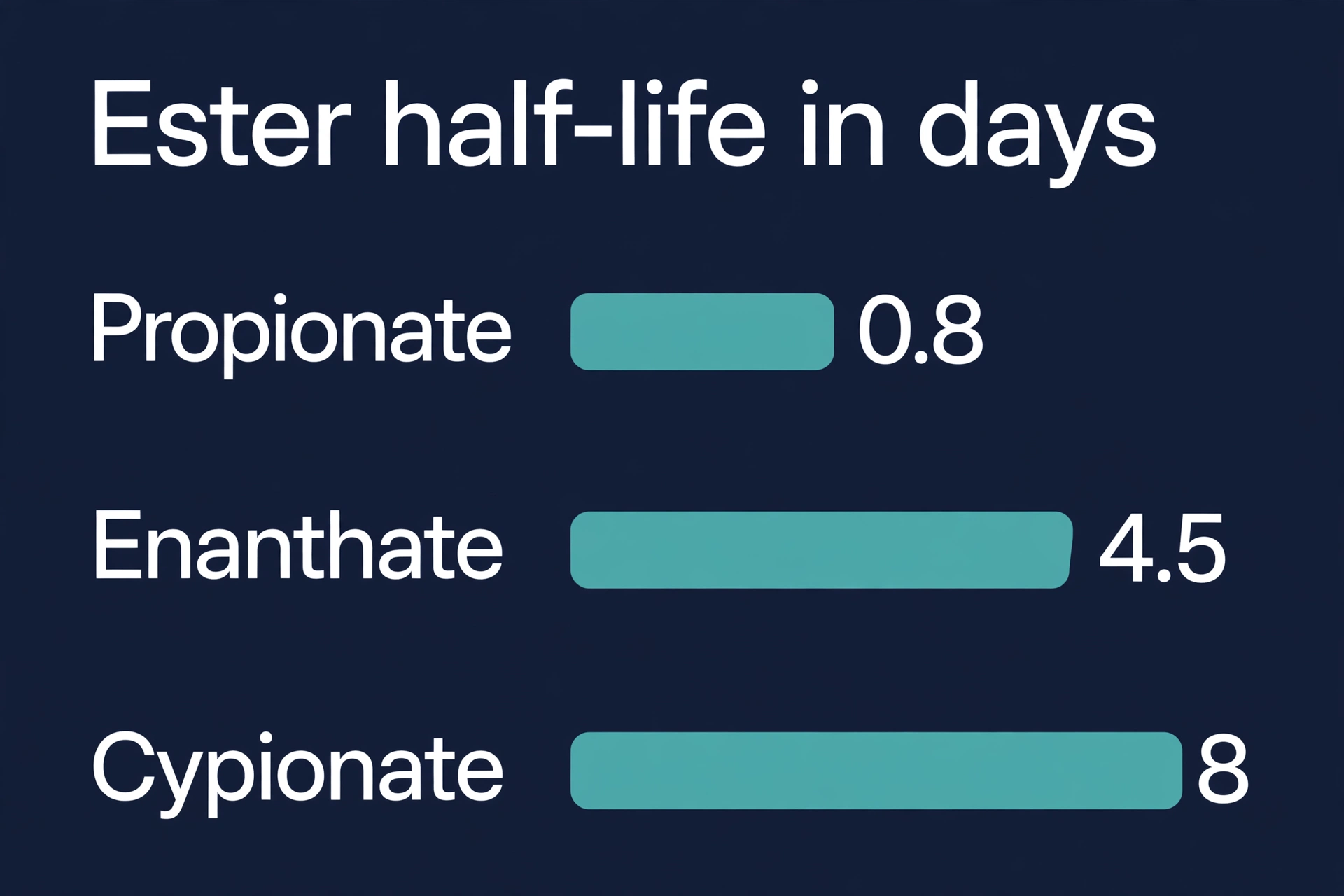
For a first cycle, either long ester works. The store’s Testosterone Enanthate 250 and Testosterone Cypionate 250 are the two products most first-time users compare — consistency beats ester trivia.
Dosage: what “300–500 mg per week” actually means
The 300–500 mg per week range is the one most commonly reported for a first testosterone cycle. It is not a prescription or a medical guideline — it is the range community protocols converge on as enough for a clear effect without immediately multiplying side effects. For context, the best-known controlled trial is Bhasin and colleagues (1996): 43 healthy young men received 600 mg of testosterone enanthate weekly for 10 weeks, and those who also trained gained an average of 6.1 kg of fat-free mass, added 22 kg to their bench press and 38 kg to their squat capacity, versus much smaller changes on placebo. That was a supervised study at a supraphysiologic dose, not a recommendation.
Two practical points matter more than the exact milligram figure. First, split the weekly dose into two injections (for example Monday and Thursday). A single large weekly injection produces a higher peak and a deeper trough, which is when estrogen symptoms and mood swings tend to appear. Second, do not front-load or pyramid on a first cycle. A steady dose from week one lets you read your body’s response cleanly, and it keeps blood levels predictable for bloodwork.
Injection schedule and sterile technique
A typical first-cycle calendar is 10 to 12 weeks of twice-weekly injections, then a waiting period while the ester clears, then PCT. Keep a written log of date, site and dose. Rotate sites (glutes, ventrogluteal area, thighs) to avoid scar tissue and repeated irritation at one spot.
Sterile technique is non-negotiable: wash hands, wipe the vial top and skin with alcohol, use a fresh sterile needle and syringe every time, never share needles or vials, and never inject into a painful, red or swollen area. An abscess from a contaminated injection is a hospital problem, not a gym problem. If you develop fever, spreading redness or a hot, swollen lump at an injection site, see a doctor promptly and be honest about what was injected — clinicians treat this routinely and need accurate information to help you.

Estrogen management: control, don’t crush
Testosterone converts to estrogen (estradiol) through aromatization, and at cycle doses estradiol rises. Some rise is normal and even useful — estrogen supports joints, libido and mood. Problems (water retention, nipple sensitivity or tenderness, rising blood pressure) appear when it climbs too far, and the beginner mistake is the opposite one: taking a large aromatase inhibitor dose pre-emptively and crashing estrogen, which brings joint pain, low libido and fatigue of its own.
The sane approach is symptom-plus-bloodwork driven: have an aromatase inhibitor on hand, use the smallest dose that resolves symptoms, and confirm with estradiol on bloodwork rather than guessing. Our estrogen management guide explains the drug classes and the signs in detail, and the store’s post cycle therapy category covers the ancillaries most cycles rely on. If nipple tenderness appears and does not settle, or a lump forms, get medical advice promptly — that is not something to wait out.
Bloodwork: before, during and after
Bloodwork is the difference between a cycle you understand and a cycle you guess at. At minimum, get a baseline panel before starting: total and free testosterone, estradiol, complete blood count (haematocrit and haemoglobin), liver enzymes, kidney function, and a lipid panel. Repeat the key markers mid-cycle (around week 6) and again after PCT, to track testosterone, estradiol and haematocrit, and to confirm recovery afterwards.
Haematocrit deserves special attention: if it climbs too high, blood thickens and clot risk rises — a doctor can advise on management. Lipids usually worsen (HDL falls). If any result is far outside range, or if you have chest pain, breathlessness, severe headache or leg swelling at any point, seek urgent medical care and disclose use.
PCT timing and structure
Starting PCT too early is one of the most common first-cycle errors. While the ester is still releasing testosterone, your natural production stays suppressed, so PCT cannot work yet. For enanthate and cypionate, the usual waiting period is about two weeks after the last injection; for propionate it is only a few days. Our timing guide, when to start PCT after each ester, gives the full ester-by-ester chart, and the head-to-head Nolvadex vs Clomid comparison explains which PCT drug fits which situation.
A standard first-cycle PCT is four weeks of a SERM such as tamoxifen or clomifene, followed by bloodwork to confirm that testosterone has recovered toward baseline. If recovery stalls, that is a medical conversation, not a reason to start another cycle to feel normal again. Repeated cycles without recovery are how temporary suppression becomes a long-term problem.
Side effects and the honest risk picture
The common, usually reversible effects are acne and oily skin, hair shedding in those genetically prone to it, testicular shrinkage during the cycle, reduced sperm count, water retention and raised blood pressure. The serious risks are less common but real: adverse lipid and haematocrit changes, worsening of undiagnosed prostate or heart disease, and dependence. A pooled analysis by Pope and colleagues (2014) estimated that 32.5% of anabolic-steroid users develop dependence (95% confidence interval 25.4–39.7%), often driven by the fear of losing gains and by the low mood that follows a cycle. Planning PCT and post-cycle training before the first injection — not after the last one — is the practical guard against that trap.
The numbers, in one place: in Bhasin’s 1996 trial, 600 mg of testosterone enanthate per week for 10 weeks plus training added 6.1 kg of fat-free mass and 38 kg of squat capacity; in Pope’s 2014 pooled analysis, 32.5% of users met dependence criteria; and the half-life gap that shapes injection schedules is 4.5 days for enanthate versus about 8 days for cypionate. Every figure above traces to the References below.
Frequently asked questions
How long should a first testosterone cycle last?
Ten to 12 weeks is the commonly reported range for a long ester. Shorter cycles barely reach steady state; longer ones add side-effect exposure without teaching you anything new.
Should I use enanthate or cypionate for my first cycle?
Either. Their release profiles are close enough that injection frequency (twice weekly for both) and dose consistency matter far more than the ester choice. Pick the one you can obtain and dose reliably for the full 12 weeks.
Do I need an aromatase inhibitor from day one?
No. Have one available, but start it only if symptoms appear or bloodwork shows estradiol out of range — starting blind risks crashing estrogen.
When exactly do I start PCT after testosterone enanthate?
About two weeks after your last injection, once the ester has largely cleared — starting earlier wastes the PCT window; see the full timing chart in our PCT timing guide.
Disclaimer: This article is educational information from the Oxygen Anabolics team, not medical advice. Anabolic steroids are controlled substances in Canada and carry health and legal risks. Speak with a qualified healthcare professional before making any decision about use, and seek prompt medical care for any worrying symptom.
References
- Bhasin S, Storer TW, Berman N, et al. The effects of supraphysiologic doses of testosterone on muscle size and strength in normal men. New England Journal of Medicine. 1996;335(1):1–7. PubMed PMID 8637535.
- Pope HG Jr, Wood RI, Rogol A, Nyberg F, Bowers L, Bhasin S. Adverse health consequences of performance-enhancing drugs: an Endocrine Society scientific statement. Endocrine Reviews. 2014;35(3):341–375. PubMed PMID 24423981.
- Kicman AT. Pharmacology of anabolic steroids. British Journal of Pharmacology. 2008;154(3):502–521. PMCID PMC2439524.
- Nieschlag E, Vorona E. Mechanisms in Endocrinology: Medical consequences of doping with anabolic androgenic steroids: effects on reproductive functions. European Journal of Endocrinology. 2015;173(2):R47–R58. PubMed PMID 25805894.