Blog
HGH Side Effects: Carpal Tunnel, Insulin Resistance, and What the Studies Actually Show

The most common side effects of human growth hormone (HGH) are not exotic: they are the predictable results of fluid retention. In adults treated for growth hormone deficiency, the symptoms reported most often are swollen ankles and hands, stiff or aching joints, muscle aches, and tingling or numbness in the fingers — and in about 2% of treated patients, those fluid changes compress the median nerve enough to cause carpal tunnel syndrome. Most of these effects are dose-dependent and usually improve when the dose is reduced, which is why clinical practice starts low and titrates slowly rather than starting at a fixed high dose.
The second major risk is metabolic. Growth hormone opposes insulin, so it can worsen insulin resistance and raise blood glucose, especially with pre-existing impaired glucose tolerance. This guide separates what studies actually measured from the reassurance that “HGH is safe because it is natural.” It is educational information, not medical advice: anyone considering HGH should first speak with a doctor and get baseline bloodwork. Oxygen Anabolics publishes these guides so readers can judge claims against evidence rather than marketing.
The Numbers at a Glance
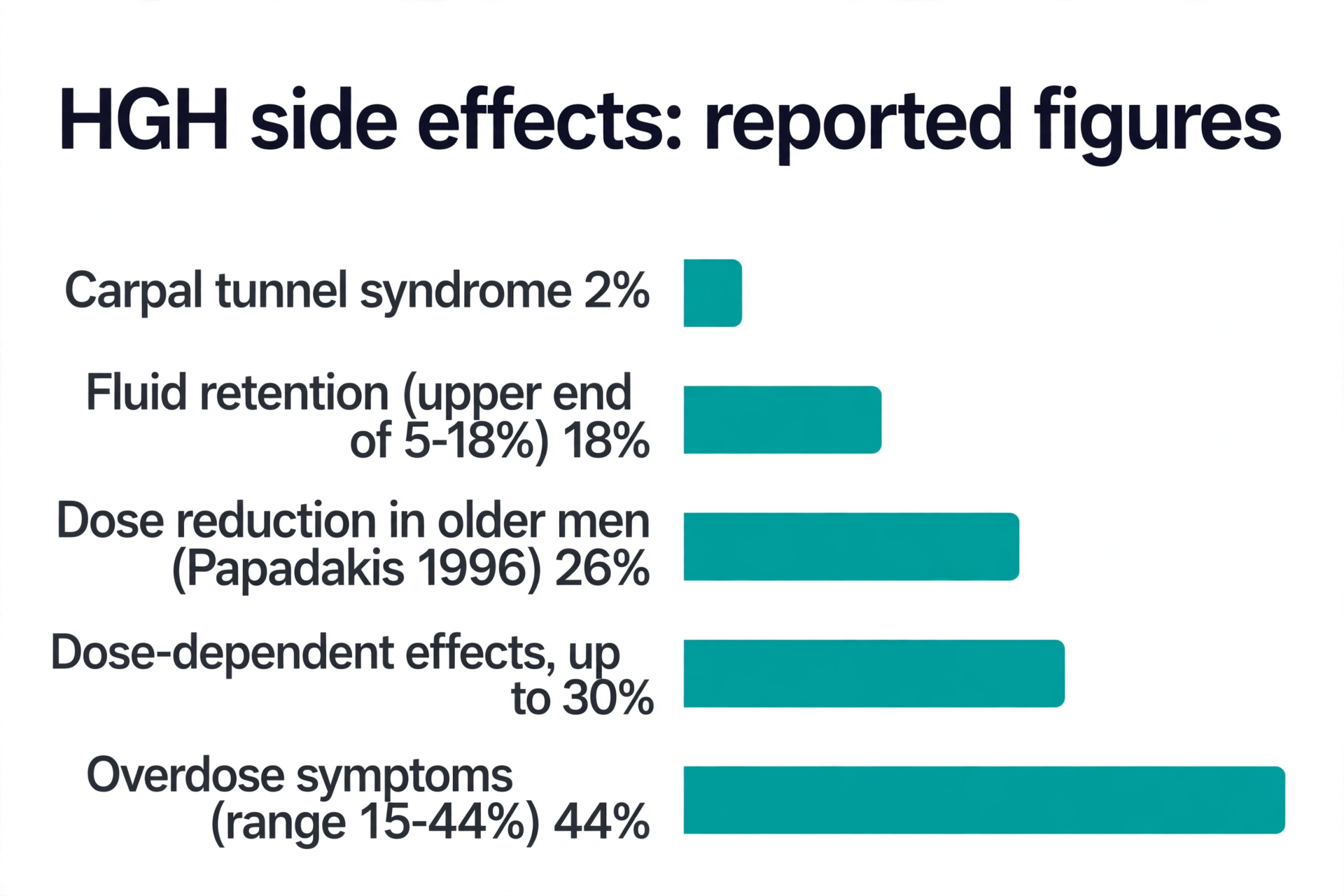
Side-effect figures come from different populations — deficient adults on replacement doses, healthy older men in trials, and people using much higher doses — so they should never be blended into one rate. The table keeps each figure with its own population; the chart repeats the same numbers visually.
| Finding | Reported figure | Population and source |
|---|---|---|
| Fluid-retention symptoms (edema, arthralgia, myalgia, paresthesia) | 5–18% of patients | Adults with growth hormone deficiency on replacement therapy (Endocrine Society guideline literature) |
| Carpal tunnel syndrome | About 2% of treated patients | Adults with growth hormone deficiency on replacement therapy |
| Dose-dependent side effects overall | Up to 30% of patients | Truly growth-hormone-deficient adults (review of the replacement literature) |
| Dose reduction needed for side effects | 26% of HGH recipients, 0% on placebo | 52 healthy men aged 70–85, 6 months of HGH (Papadakis 1996) |
| Typical overdose symptoms (edema, arthralgia, carpal tunnel, sweating) | 15–44% of participants | Studies of higher-than-recommended doses, summarised by Holt and Sonksen (2008) |
Read the labels, not just the bars: 18% is the upper end of the 5–18% range, 44% the upper end of the 15–44% range, and 30% an “up to” figure, each from a different study. Do not average them.
Carpal tunnel syndrome — 2%
Fluid retention, upper end of 5–18% — 18%
Dose reduction in older men (Papadakis 1996) — 26%
Dose-dependent effects, up to — 30%
Overdose symptoms, upper end of 15–44% — 44%
Fluid Retention: The Effect Behind Most Early Symptoms
Growth hormone promotes sodium and water retention, and that mechanism explains most early complaints: puffy hands and ankles, rings that feel tight, morning joint stiffness, and tingling fingers. The guideline literature describes these as the most common side effects in deficient adults (5–18% of patients), generally responsive to dose reduction, and usually appearing in the first few weeks.
Carpal tunnel syndrome deserves its own paragraph because it is most likely to be mistaken for a training injury. Extra fluid in the wrist raises pressure in the carpal tunnel and compresses the median nerve, producing numbness, tingling or weakness in the thumb, index and middle fingers, often worse at night. At about 2% of treated deficient adults it is uncommon, but persistent numbness, hand weakness, or symptoms that do not ease after a dose reduction should be checked by a doctor rather than trained through.
Insulin Resistance and Blood Glucose: The Metabolic Trade-Off
Growth hormone is an insulin antagonist: it stimulates glucose production by the liver and reduces glucose uptake in peripheral tissues, so it can raise fasting glucose even while body composition improves. In a randomised, double-blind, placebo-controlled trial, 77 HIV-infected adults with abdominal fat and insulin resistance were randomised (72 started treatment) to recombinant HGH 3 mg daily, rosiglitazone, both, or placebo for 12 weeks. In the HGH-only arm, insulin sensitivity fell significantly versus control (P = 0.03) and fasting glucose and glucose area under the curve rose — while visceral fat fell 22.7% versus 1.9% in the control arm.
Three practical points follow. First, the glucose effect is not a reason to assume diabetes is inevitable, nor a reason to dismiss it: in that trial the effect was measurable at 12 weeks at a supraphysiologic 3 mg daily dose, and other studies have found glucose measures worsening early and then moving back toward baseline with longer treatment — which is exactly why monitoring, not guessing, matters. Second, anyone with pre-existing impaired glucose tolerance, diabetes, or a strong family history of diabetes is in a higher-risk group and should have glucose and HbA1c checked before and during any HGH use, under a doctor’s care. Third, symptoms such as unusual thirst, frequent urination, or unexplained fatigue during HGH use should prompt a glucose check, not a wait-and-see approach. The HGH category is the hub for this series, and our HGH dosage guide explains why clinical starting doses are far lower than most online figures.

Less Common and Rare Effects Worth Knowing
Headaches, injection-site soreness, and mild aches are reported, but two rarer effects require prompt care. Benign intracranial hypertension — raised pressure inside the skull without a tumour — is very rare in adults on HGH, but a new severe or persistent headache, especially with blurred or double vision, should be treated as urgent. Sleep apnea can also worsen; loud new snoring, witnessed pauses in breathing, or severe daytime sleepiness should be raised with a doctor.
One qualifier runs through this entire article: a deficient adult on a titrated replacement dose is not the same population as a GH-replete person on a much larger dose, and long-term safety data from the first group do not prove safety at the higher doses used outside medicine.
Who Is Most at Risk, and Why Dose Titration Matters
Risk is not evenly spread: older patients, heavier patients, and women are more prone to fluid-retention complications, most of which improve with dose reduction. The pattern is visible even in healthy older men at modest doses: in Papadakis and colleagues’ 1996 trial, 52 healthy men aged 70 to 85 received HGH or placebo three times a week for six months. Lean mass rose 4.3% and fat mass fell 13.1% in the HGH group, but functional ability did not improve, and dose reduction was required in 26% of HGH recipients versus none on placebo.
That trial illustrates why “start low, titrate slowly” is not boilerplate: the guideline summary reports that titration at initiation, instead of a weight-based starting dose, reduced adverse-event incidence by 50%. In practice: a low starting dose, small increases weeks apart, IGF-1 and glucose monitoring, and stepping back down at the first persistent fluid or nerve symptom. Our HGH benefits guide covers what replacement therapy is actually shown to improve, so readers can weigh benefits against these risks rather than marketing claims.
What to Monitor: A Harm-Reduction Checklist
No checklist makes unsupervised HGH use safe, but anyone discussing HGH with a doctor should expect the following. Before starting: IGF-1, fasting glucose and HbA1c, blood pressure, and a review of sleep apnea, carpal tunnel, diabetes, and pituitary or eye history. During use: repeat blood pressure, glucose, HbA1c, and IGF-1 checks, plus a diary of ankle swelling, ring tightness, morning stiffness, finger tingling, headaches, and sleep quality, so a dose-related pattern is visible.
Injection hygiene matters for any injectable product: sterile technique, single-use needles and syringes, never sharing equipment, and proper storage as directed. See also our testosterone and HGH synergy guide and the guide to HGH options in Canada.
Seek medical care promptly if you notice:
- Persistent numbness, tingling, or weakness in the hands, or symptoms that do not ease after a dose reduction.
- Severe or persistent headache, or any change in vision such as blurring or double vision.
- Marked swelling, rapid weight gain over days, shortness of breath, or a large rise in blood pressure.
- Unusual thirst, frequent urination, or unexplained fatigue that could signal rising blood glucose.
- New loud snoring, witnessed pauses in breathing during sleep, or severe daytime sleepiness.
The two formats most readers ask about are the OptiTropin HGH 120 IU kit and the HGH 240 IU kit. Total IU in a kit is a quantity, not a dose recommendation: daily dose, titration, and monitoring are decisions for a doctor, informed by IGF-1, glucose, and symptoms — not by kit size.
Frequently Asked Questions
Is HGH-related carpal tunnel syndrome permanent?
Usually not. Fluid-retention effects including carpal tunnel symptoms generally improve with dose reduction or stopping treatment, but persistent numbness or hand weakness should be assessed by a doctor rather than assumed to resolve on its own.
Does HGH cause diabetes?
HGH can worsen insulin resistance and raise blood glucose — in the 12-week trial above, insulin sensitivity fell significantly in the HGH arm versus control. That does not mean HGH inevitably causes diabetes in every user, but people with impaired glucose tolerance or diabetes are at higher risk, and glucose monitoring is essential.
How soon do HGH side effects appear?
Fluid-retention symptoms and carpal tunnel syndrome, when they occur, usually appear in the first few weeks, tracking the initial fluid shift. Glucose changes can also appear within weeks, which is why baseline and early follow-up bloodwork matter more than a single late check.
Are HGH side effects dose-dependent?
Yes — the most actionable fact in this guide. Higher doses produce more fluid retention, joint symptoms, and glucose disturbance; starting low and titrating slowly reduced adverse-event incidence by 50% versus a weight-based starting dose in the guideline summary. Dose reduction, under medical supervision, is the first-line response to most HGH side effects.
References
- Molitch ME, Clemmons DR, Malozowski S, Merriam GR, Vance ML; Endocrine Society. Evaluation and treatment of adult growth hormone deficiency: an Endocrine Society clinical practice guideline. Journal of Clinical Endocrinology & Metabolism. 2011;96(1587–1609.
- Reed ML, Merriam GR, Kargi AY. Adult growth hormone deficiency — benefits, side effects, and risks of growth hormone replacement. Frontiers in Endocrinology. 2013;4:64.
- Papadakis MA, Grady D, Black D, Tierney MJ, Gooding GAW, Schambelan M, Grunfeld C. Growth hormone replacement in healthy older men improves body composition but not functional ability. Annals of Internal Medicine. 1996;124:708–716.
- Glesby MJ, Albu J, Chiu Y-L, Ham K, Engelson E, He Q, et al. Recombinant human growth hormone and rosiglitazone for abdominal fat accumulation in HIV-infected patients with insulin resistance: a randomized, double-blind, placebo-controlled, factorial trial. PLoS ONE. 2013;8(4):e61160.
Disclaimer: Educational information only, not medical advice. HGH affects fluid balance, glucose metabolism, and nerve compression risk. Do not start, stop, or change hormone treatment based on this article alone — speak with a qualified doctor, get baseline and follow-up bloodwork, and seek prompt care for any symptom listed above.