

Blog
Testosterone Enanthate vs Cypionate: Half-Life, Injection Frequency & Which Ester Fits Your Cycle

Ask which testosterone ester is better — enanthate or cypionate — and you will get a confident answer within seconds. Ask what actually differs between them and the answer is much quieter: almost nothing, except how long each one lasts in the body. Both deliver the same hormone, testosterone. They differ only in the ester attached to it, and that ester controls how slowly the hormone is released from the injection site. Everything else — muscle-building effect, side-effect profile, and the bloodwork you should watch — is essentially shared.
The short version: testosterone enanthate has a terminal half-life of about 4.5 days, while testosterone cypionate lasts longer at roughly 8 days. In practice that means enanthate suits a weekly rhythm and cypionate can stretch a little further between injections, but neither ester is stronger per milligram in any meaningful sense, and switching between them is straightforward. The rest of this guide compares the numbers, the injection schedules, and the practical trade-offs, so you can choose on pharmacology rather than forum lore.
What the two esters actually are
Testosterone esters are testosterone molecules with a fatty-acid chain attached at the 17-beta position. The chain makes the hormone oil-soluble, so that after an intramuscular injection it sits in a small oil depot and is released slowly as enzymes clip the ester off and free the testosterone. A longer, heavier chain means slower release: enanthate carries a 7-carbon chain, cypionate an 8-carbon chain with a ring structure. That single-carbon difference is the whole story behind the half-life gap.
Both esters are long-established in clinical medicine. Testosterone enanthate has been the standard injectable form of testosterone replacement for decades, and cypionate has been used alongside it in North America for just as long. The products differ in their carrier oils — enanthate is typically dissolved in sesame oil and cypionate in cottonseed oil — which matters only if you have an allergy to one of those oils. If you react to one ester preparation, the oil is worth checking before blaming the hormone itself.
On the store side, the two standard presentations are testosterone enanthate 250 mg/mL and testosterone cypionate 250 mg/mL: the same concentration, different ester, different release speed.
The numbers that matter
Three verified numbers frame the entire comparison. First, the terminal half-life of testosterone enanthate after intramuscular injection is 4.5 days (Behre et al., 2004). Second, the half-life of testosterone cypionate is approximately 8 days according to its prescribing information, with reviews reporting a 6 to 8 day range. Third, a 2023 review of testosterone therapies reports a half-life of about 173 hours — roughly 7.2 days — for intramuscular testosterone generally, and notes that cypionate and enanthate are typically injected every one to two weeks in clinical practice (Gurayah et al., 2023).
One more number belongs in any honest discussion of testosterone: the diagnostic threshold. The American Urological Association defines testosterone deficiency as two total morning testosterone measurements below 300 ng/dL together with symptoms (cited in Gurayah et al., 2023). That threshold is about diagnosis, not cycles — but it anchors bloodwork in measured values, not feelings.
Enanthate vs cypionate: the head-to-head table
| Feature | Testosterone enanthate | Testosterone cypionate |
|---|---|---|
| Ester side chain | 7-carbon enanthate | 8-carbon cypionate (cyclopentylpropionate) |
| Terminal half-life | About 4.5 days | About 8 days (reviews report 6–8 days) |
| Typical clinical injection interval | Every 7 days, or every 1–2 weeks | Every 7–14 days, or every 1–2 weeks |
| Typical carrier oil | Sesame oil | Cottonseed oil |
| Active hormone delivered | Testosterone | Testosterone |
| Peak after injection | Within 24–48 hours, then gradual decline | Within 24–48 hours, then slower decline |
| Common on-site strength | 250 mg/mL | 250 mg/mL |
The rows that matter are half-life and interval; everything else is identical or near-identical — which is why experienced users call the esters interchangeable, apart from timing.
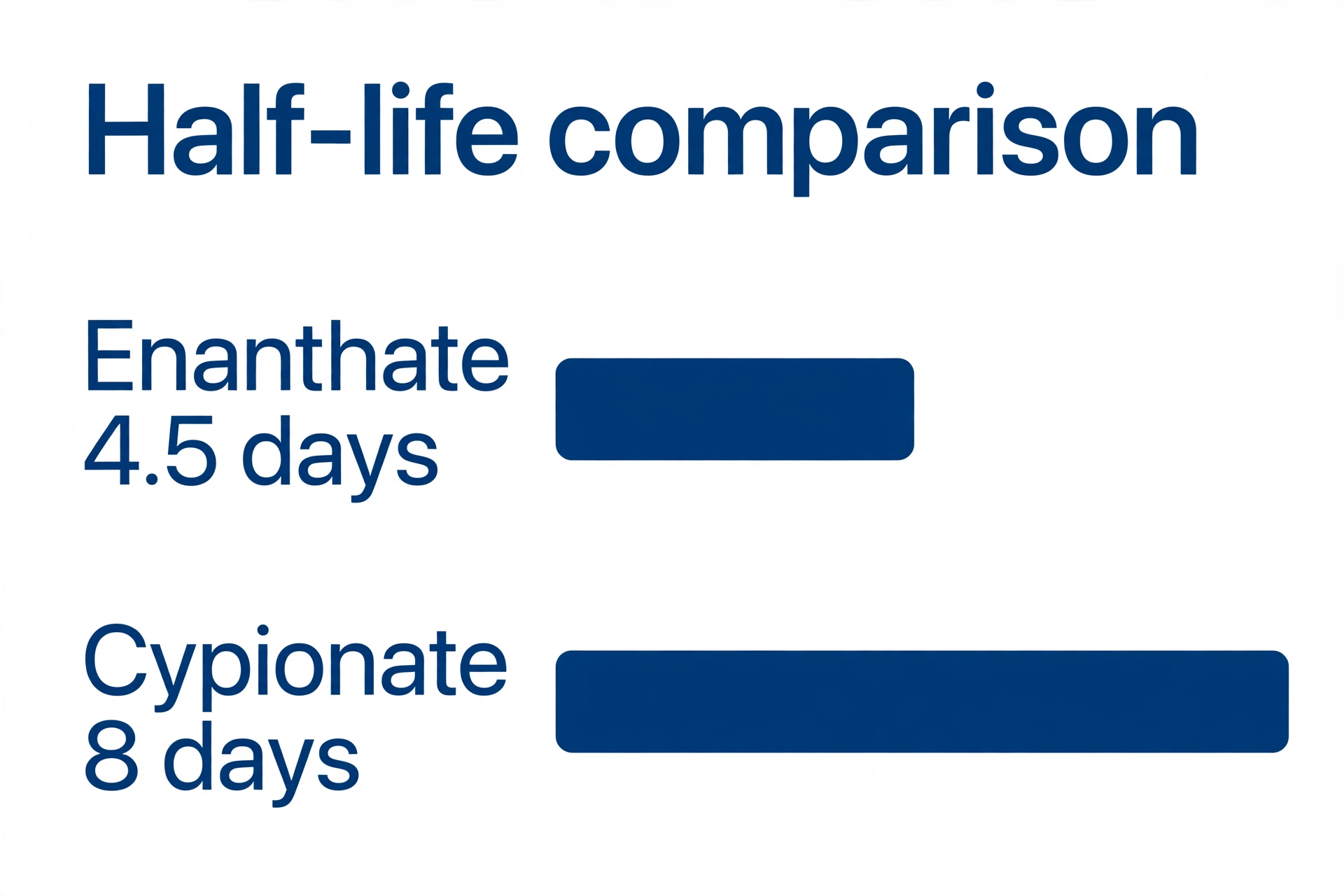
Terminal half-life in days (from the table above)
4.5
8
Enanthate 4.5 days (Behre et al., 2004); cypionate about 8 days per prescribing information, with reviews reporting 6–8 days. Values are approximate and vary between individuals and studies.
Injection frequency in practice
Half-life translates into scheduling, not into results. With a 4.5-day half-life, enanthate levels fall noticeably across a two-week gap, so a weekly injection — or a split dose twice a week — keeps levels steadier. Cypionate’s longer half-life forgives a longer gap: every 10 to 14 days is workable, and weekly injections are smoother still. Clinicians prefer the same pattern for either ester: smaller doses more often, since large, infrequent doses create a high peak followed by a low trough, when symptoms and mood swings most often return.
Splitting the dose is the single most useful scheduling trick for both esters. Half the weekly amount every 3 to 4 days flattens the peak-to-trough swing, which tends to mean steadier energy, steadier libido, and less aromatization pressure at the peak. It costs one extra injection a week and it is the closest a simple schedule gets to mimicking natural production. Whichever ester you use, the calendar illustration in this article makes the same point: consistency matters more than the exact day you pick.

On technique, where harm actually happens: use sterile technique every time, rotate sites, never share needles or vials, and never inject into a vein. The Endocrine Society’s scientific statement documents injection-related harms from non-sterile practice, including abscesses and infections from contaminated products or needles (Pope et al., 2014). If you develop fever, spreading redness, or a painful lump after an injection, see a doctor promptly rather than waiting it out.
Switching between esters
Switching is simple because the hormone is the same. If you move from enanthate to cypionate, or the reverse, keep the same weekly milligram amount and the same injection day; the only change is that levels will drift slightly as the old ester washes out over one to two weeks. There is no need for a washout period, a loading dose, or a gap between esters, and bloodwork drawn less than four weeks after a switch will still partly reflect the old ester.
The one genuine reason to switch is tolerability: an allergy or irritation linked to a carrier oil, or availability. A second reason is schedule preference — someone who travels may prefer cypionate’s longer interval, while someone who already injects twice a week gains nothing from it.
Side effects, estrogen, and bloodwork
Because both esters deliver testosterone, their side-effect profiles are the same: acne and oily skin, hair shedding in those genetically predisposed, suppression of natural testosterone production and fertility, raised hematocrit (thicker blood), reduced HDL cholesterol, and conversion of some testosterone to estradiol, which can cause water retention and gynecomastia. The Endocrine Society’s statement lists these as well-recognized effects of anabolic-androgenic steroid use, with cardiovascular, neuroendocrine, and dermatologic consequences among the most common (Pope et al., 2014). Ester choice does not avoid any of them; dose, duration, and individual susceptibility decide that.
Bloodwork is the harm-reduction tool that matters most. Before starting, and periodically during use, check total and free testosterone, estradiol, hematocrit and hemoglobin, lipids, liver enzymes, and PSA where age-appropriate, and discuss the results with a doctor. Our estrogen management guide explains how estradiol is controlled and why crashing it with too much aromatase inhibitor causes its own problems — joint pain, low libido, and low mood. For background on what cypionate does beyond the ester question, see our cypionate benefits guide.
Which ester fits your cycle?
Choose enanthate if you already inject weekly, if you prefer the ester with the longest clinical track record, or if you are following a protocol written around it — which most older cycle guides are. Choose cypionate if you want the longest gap between injections, if you travel, or if you have reacted to a sesame-oil preparation before. If you are choosing a first cycle, the ester is one of the least important decisions you will make; the dose, the cycle length, the post-cycle plan, and the bloodwork matter far more. Our Test E 250 guide and best testosterone for bulking guide cover those decisions in more depth, and the wider injectable steroids category puts both esters alongside the other long-acting options.
The honest verdict is that enanthate and cypionate are two versions of the same drug with a modest timing difference. Pick the one whose schedule you will actually follow, keep the dose the same if you ever switch, and let bloodwork — not forum enthusiasm — tell you whether the protocol is working. That is the approach Oxygen Anabolics takes across its guides: the pharmacology first, the marketing second.
Frequently asked questions
Can I switch from enanthate to cypionate mid-cycle?
Yes. Both deliver testosterone, so keep the same weekly milligram amount and injection day. Levels will drift slightly for one to two weeks as the old ester washes out, and bloodwork within four weeks of the switch will still partly reflect the old ester.
Does cypionate’s longer half-life mean fewer injections?
It can, but only modestly. Cypionate supports every 10 to 14 day injections, while enanthate is usually injected weekly. In practice most users inject either ester once or twice a week, because smaller, more frequent doses keep levels steadier than large, infrequent ones.
Is one ester stronger than the other?
No, not in any meaningful sense. Milligram for milligram they deliver the same hormone; cypionate’s heavier ester means very slightly less free testosterone per milligram, a difference of a few percent that is not a reason to choose one over the other.
Do enanthate and cypionate need different post-cycle therapy timing?
Only slightly. Because cypionate clears more slowly, post-cycle therapy is typically started a few days later after cypionate than after enanthate — roughly two weeks after the last enanthate injection versus two to three weeks after cypionate — but exact timing depends on dose and cycle length, and bloodwork should confirm recovery.
References
- Behre HM, Baus S, Kliesch S, Nieschlag E. Pharmacology of testosterone preparations. In: Nieschlag E, Behre HM, eds. Testosterone: Action, Deficiency, Substitution. Cambridge University Press; 2004:405–444.
- Gurayah AA, Dullea A, Weber A, Masterson JM, Khodamoradi K, Mohamed A, Ramasamy R. Long vs short acting testosterone treatments: A look at the risks. Urology. 2023. PMID: 36455678; PMCID: PMC9925408.
- Kicman AT. Pharmacology of anabolic steroids. British Journal of Pharmacology. 2008;154(3):502–521. PMCID: PMC2439524.
- Pope HG Jr, Wood RI, Rogol A, Nyberg F, Bowers L, Bhasin S. Adverse health consequences of performance-enhancing drugs: An Endocrine Society scientific statement. Endocrine Reviews. 2014;35(3):341–375. PMID: 24423981.
Disclaimer: This article is educational information only and is not medical advice. Testosterone is a controlled substance in Canada, and non-prescribed use carries legal and health risks. If you use or are considering testosterone, discuss bloodwork, fertility, cardiovascular risk, and safer-use planning with a qualified doctor, and seek medical care promptly for fever, spreading redness, chest pain, breathlessness, or severe mood changes.