Blog
BPC-157 Dosage Guide: How Much, How Often, and How Long?
Ask what dose of BPC-157 people take and you will get a confident number within seconds. Ask what dose has actually been established in humans and the answer is very different: there is no established human dose for BPC-157. It is not an approved medicine, it has no approved prescribing information, and no dose-finding trial in healthy adults has defined a safe and effective amount. This guide separates what animal studies used, what community protocols report, and what remains unknown, so you can read the numbers circulating online for what they are.
The short version: animal studies used 6 micrograms to 20 milligrams per kilogram across different routes and schedules, while community discussions cluster around 250 to 1,000 micrograms per day in one or two doses. Those community figures are not clinical recommendations, are not validated by human trials, and a higher figure is not evidence of a better result.
What BPC-157 actually is
BPC-157, short for body protection compound-157, is a synthetic pentadecapeptide: a chain of 15 amino acids based on a fragment of a protein found in human gastric juice. In laboratory and animal research it has been studied for its effects on tissue repair, blood-vessel formation, and inflammation. Reviews describe it as acting through overlapping pathways, including VEGFR2 signalling and nitric oxide synthesis, which promote angiogenesis, fibroblast activity, and the repair of tendon, ligament, muscle, and bone tissue in animal models (McGuire et al., 2025; Vasireddi et al., 2025).
That mechanism is plausible, but excitement usually outruns evidence here. Animal models have shown improved outcomes, while human evidence is limited to small pilot studies with no control groups and no large trials. Until such trials exist, BPC-157 is investigational, not a proven treatment.
The numbers that matter, before any dose
A 2025 systematic review screened 544 articles published between 1993 and 2024 and included 36 studies. Of those 36, 35 were preclinical and only 1 was clinical. In that single human study, a retrospective review of people with chronic knee pain who received BPC-157 injected into the knee joint, 7 of 12 patients reported relief lasting more than six months (Vasireddi et al., 2025). A separate 2025 narrative review counted only three pilot studies in humans in total, covering knee pain, interstitial cystitis, and intravenous safety and pharmacokinetics, with no adverse effects reported but no rigorous efficacy data either (McGuire et al., 2025).
Two further numbers frame every dosing discussion. In preclinical work BPC-157 was metabolised in the liver with a half-life of less than 30 minutes and cleared by the kidneys (Vasireddi et al., 2025), and the same review found no clinical safety data in humans. Preclinical safety studies showed no adverse effects across several organ systems, but that is not demonstrated safety in people or about long-term use.
BPC-157 dosage frameworks compared
The table below is the heart of this guide. Read the right-hand column first: it tells you whether each row is animal evidence, community reporting, or an established human dose. Only the last row is a clinical fact, and it is a negative one.
| Framework | Per-dose amount | Frequency | Daily total | Evidence status |
|---|---|---|---|---|
| Animal research (preclinical) | 6 mcg/kg to 20 mg/kg | Varied by study | Not a human daily total | Animal models only; routes and schedules varied widely |
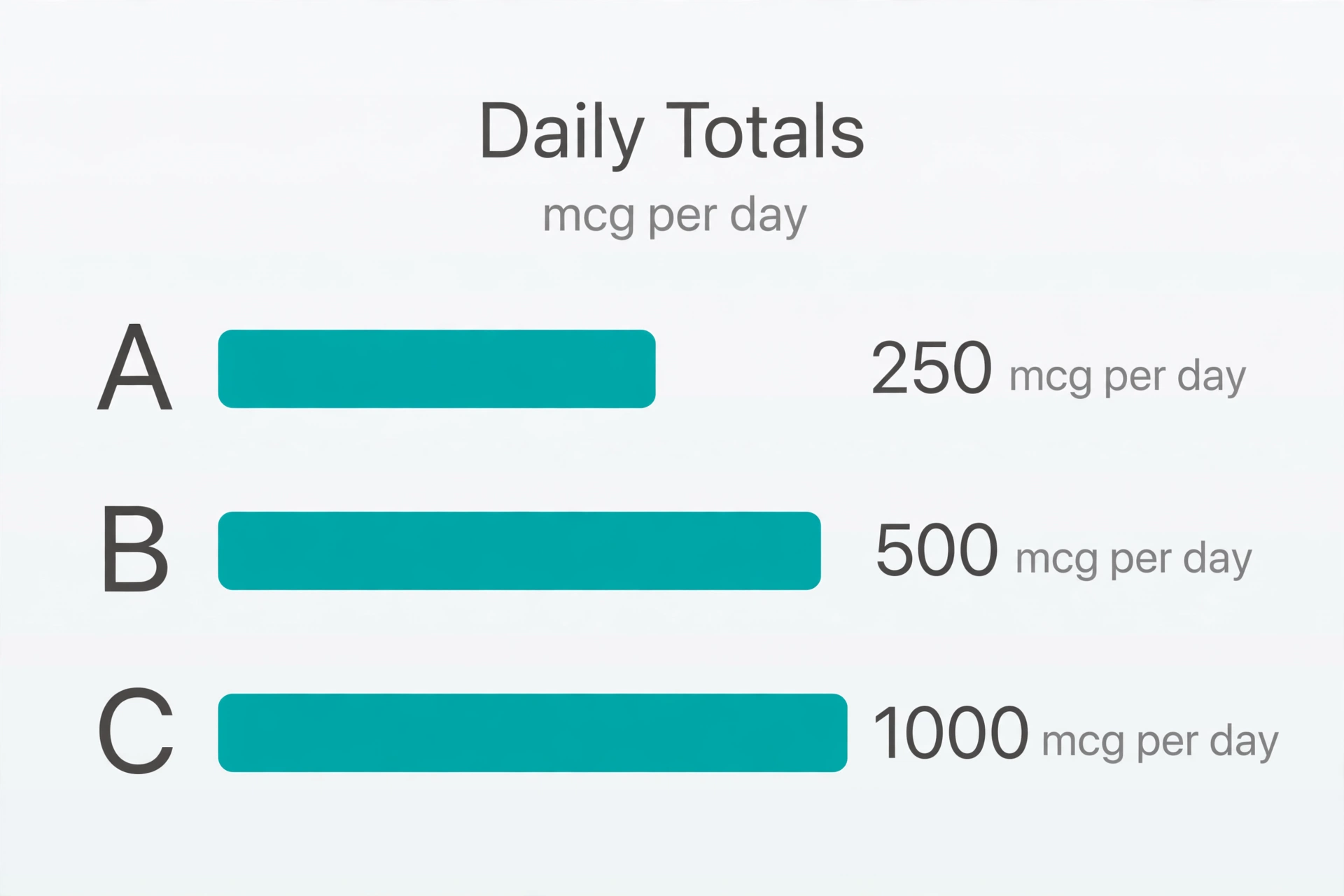
| Community example A | 250 mcg | Once daily | 250 mcg/day | Community-reported; not clinically validated |
| Community example B | 250 mcg | Twice daily | 500 mcg/day | Community-reported; not clinically validated |
| Community example C | 500 mcg | Twice daily | 1,000 mcg/day | Community-reported; not clinically validated |
| Established human dose | None | None | None established | No dose-finding trial; no approved prescribing information |
The animal range is so wide it is almost meaningless as a dosing guide: 6 micrograms to 20 milligrams per kilogram covers more than a 3,000-fold difference, across different injury models, routes, and durations. You cannot pick a point inside it, scale it to a human, and call the result a dose. Community numbers came from forum and vendor practice, not from that calculation.
That is also why the popular BPC-157 5 mg vial format tells you nothing about dose on its own. Five milligrams is the amount of peptide in the vial, not a daily amount or a course. At 250 micrograms per day, a 5 mg vial would last 20 days; at 1,000 micrograms per day it would last 5 days. Both arithmetic statements are true, and neither one is a recommendation. Vial size is packaging, not prescribing.
How often: what frequency really means here
Most community protocols split the daily total into one or two doses, usually morning and evening, on the reasoning that a short half-life means splitting keeps levels steadier. That reasoning is flawed: the half-life figure comes from animal intramuscular or intravenous work, not human subcutaneous dosing, and a short plasma half-life does not automatically make twice-daily dosing better or safer. Tissue effects may outlast plasma levels, or they may not; nobody has measured that in humans.
Community-reported daily totals (mcg per day) — not established doses
250
500
1,000
From the table above: A is 250 mcg once daily, B is 250 mcg twice daily, C is 500 mcg twice daily. Community-reported, not validated doses.
How long: cycle length and the missing evidence
Community reports describe 4 to 6 weeks as standard, 6 to 8 weeks as extended, and 8 to 12 weeks as long, often with a review point at week 4 or 6 and a 2- to 4-week break between courses. None of those durations is established by a trial: no study has compared 4 weeks against 8 weeks in humans, shown a break improves safety, or followed people long enough to characterise long-term effects.
That absence of long-term data is the strongest reason to be sceptical of open-ended use. The 2025 systematic review noted no study assessed adverse events beyond 6 weeks of follow-up in animal models, and no clinical safety data were found in humans (Vasireddi et al., 2025). Unregulated manufacturing adds a separate risk: contamination, mislabelling, and underdosing are invisible to the buyer without independent lab testing.
Reconstitution and measurement: the arithmetic, not a protocol
Lyophilised peptides arrive as a dry powder mixed with a sterile diluent, and most dosing errors in community reports are measurement errors. If a 5 mg vial is mixed with 2 mL of diluent, the concentration is 2,500 micrograms per mL, so 0.1 mL contains 250 micrograms and 0.2 mL contains 500 micrograms. Change the diluent volume and every number changes.
That example is included so readers can check claims, not as instructions: handling errors can cause infection regardless of what is in the vial. See the broader research peptides category context first, rather than treating one table as a complete guide.
BPC-157, TB-500, and stacking
BPC-157 is often discussed alongside TB-500, but they are different compounds: TB-500 is a fragment of thymosin beta-4, BPC-157 a gastric pentadecapeptide, and the evidence for one does not transfer to the other. Combining them creates no validated dose for either. Our BPC-157 + TB-500 blend listing describes the combined format, but this article covers BPC-157 alone.
Safety, sport, and when to see a doctor
BPC-157 is not approved by the US Food and Drug Administration, and it is prohibited in tested sport: it is listed under section S0 (non-approved substances) on the World Anti-Doping Code Prohibited List, prohibited at all times for athletes subject to that code (Sport Integrity Australia, 2025). A short half-life is not a detection deadline, and athletes should check their own federation’s rules rather than relying on community claims about clearance times.
Red flags for any unapproved injectable — pain, redness, swelling, or fever at an injection site, any sign of infection, or any new symptom — should prompt medical attention, not a forum post. If an injury is not improving or limits function, that is a medical conversation, not a dosing adjustment.
Frequently asked questions
What is the standard BPC-157 dosage?
There is no standard human dosage: animal studies used 6 micrograms to 20 milligrams per kilogram, community reports cluster at 250 to 1,000 micrograms per day, and no trial has validated any figure.
How often is BPC-157 taken in community protocols?
Most often once or twice daily. That split is convention, not a human pharmacokinetic finding: the under-30-minute half-life comes from animal work, and no human study shows twice-daily is better or safer.
How long does a BPC-157 cycle last?
Community reports describe 4 to 6 weeks as standard, up to 8 to 12 weeks, often with a 2- to 4-week break. No trial has established an optimal duration or break, and long-term safety is uncharacterised.
Is BPC-157 safe?
Not established. Preclinical studies showed no adverse effects across several organ systems, but the 2025 review found no clinical safety data in humans, and unregulated manufacturing adds contamination and mislabelling risks.
Bottom line
A dosage guide that gives a single number and stops there is misleading you. The honest summary: animal doses span a 3,000-fold range, community practice clusters at 250 to 1,000 micrograms per day over 4 to 12 weeks, and none of that is an established human dose. Treat every number here as a description of what was studied or reported, not as advice to take anything.
For broader background, see our BPC-157 and TB-500 therapeutic uses overview, our peptides and performance guide, and our peptide reconstitution and dosage explainer. This guide is published by Oxygen Anabolics as educational information for readers in Canada.
Disclaimer: This article is educational information only and is not medical advice. BPC-157 is not an approved medicine, has no established human dose, and is prohibited in tested sport. Do not use this article to diagnose, treat, or manage any condition. Speak to a qualified healthcare professional about any injury or health concern, and seek prompt medical attention for signs of infection or any new or worsening symptom.
References
- Vasireddi N, Hahamyan H, Salata MJ, Karns M, Calcei JG, Voos JE, Apostolakos JM. Emerging Use of BPC-157 in Orthopaedic Sports Medicine: A Systematic Review. HSS Journal. 2025;21(4):485–495. PMID: 40756949.
- McGuire FP, Martinez R, Lenz A, Skinner L, Cushman DM. Regeneration or Risk? A Narrative Review of BPC-157 for Musculoskeletal Healing. Current Reviews in Musculoskeletal Medicine. 2025;18(12):611–619. PMID: 40789979.
- Józwiak et al. Multifunctionality and Possible Medical Application of the BPC 157 Peptide — Literature and Patent Review. Pharmaceuticals. 2025;18:185.
- Sport Integrity Australia. BPC-157. Substance education page: BPC-157 is a prohibited substance listed under section S0 Non-Approved Substances on the World Anti-Doping Code Prohibited List. Accessed October 2025.